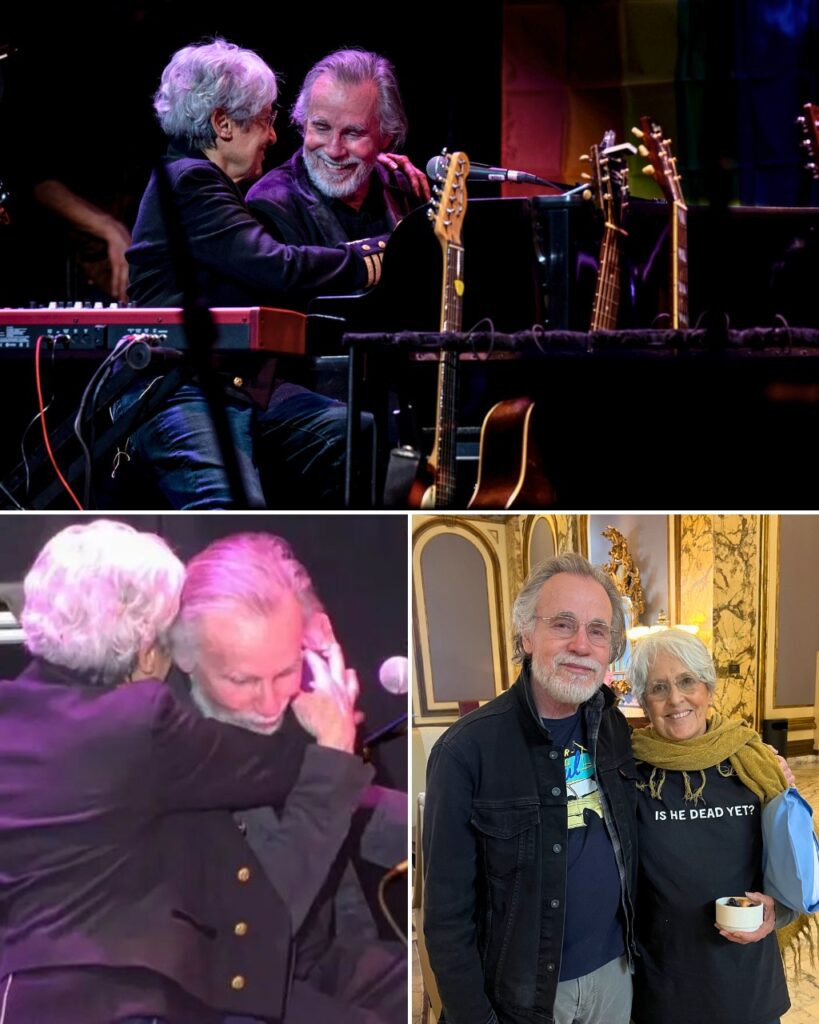
On February 8, 2025, the historic Masonic Auditorium in San Francisco became more than a venue—it became a vessel for memory, grief, hope, and the enduring power of music. That night, A Night to Honor Joan Baez transformed the ordinary into the extraordinary as legendary singer-songwriters Jackson Browne and Joan Baez shared the stage for a rendition of “Before The Deluge” that would etch itself into the hearts of everyone present. The air itself seemed to hold its breath as they began, every chord, every note, trembling with decades of experience, of protest, of love, of loss.
Written by Browne, “Before The Deluge” has always been a meditation on human choices and fragile hope, but in that duet, it became a mirror for the soul. Browne’s delicate, introspective guitar wove seamlessly with Baez’s signature voice, which has carried the weight of history, heartbreak, and courage. Together, they transformed the song into something more than music—it became a prayer, a warning, a lament, and a celebration all at once. Every word felt alive, every pause between the notes heavy with meaning. It was a dialogue between two souls who have long shaped the soundtrack of social consciousness, each phrase carrying the echoes of generations who dared to hope and fight in the face of a world that often feels indifferent.
The audience sat rapt, eyes wide, hearts swelling, some quietly weeping, others silently nodding, feeling every vibration as if it had passed straight from the performers’ hearts to theirs. This was not a performance to clap for, but a moment to inhabit. In the stillness between Baez’s trembling highs and Browne’s introspective lows, the room collectively remembered what it means to live fully, to resist, to hold hope even when the world grows darker.
The evening celebrated many artists honoring Baez’s trailblazing career in music and activism, but this duet became the night’s heartbeat. It was a reminder that music is not just entertainment—it is a lifeline, a chronicle, a call to consciousness. Their harmonies, weathered yet radiant, carried decades of protest, heartbreak, resilience, and unshakable grace, reminding everyone present that art can be both a mirror and a lantern. For those who could not attend, a high-quality video preserves the moment, capturing not just the notes but the electric silence between them, the raw vulnerability, and the lasting glow of two icons reminding the world why they have endured.
That night, surrounded by strangers yet bound by shared emotion, it became clear that what was witnessed was nothing short of a passing of a torch—a fleeting, luminous testament to the generation that dared to hope, to fight, and to believe that music could change hearts, even if it could not immediately change the world.