Compiling a greatest hits album is tricky business, especially for a band like Pink Floyd. What the members feel represents their best work doesn’t always align with public opinion or what record labels deem the most marketable.

That discrepancy became particularly clear when David Gilmour championed the inclusion of a lesser-known track, ‘Fat Old Sun,’ on their greatest hits album, but was ultimately shot down by his bandmates.

The challenge with selecting Pink Floyd’s best songs lies in their ever-evolving sound and history. Their career spans distinct eras, from their early rhythm and blues roots to the psychedelic days of Syd Barrett, and finally, their transition into one of the most influential progressive rock bands of all time. How could a single tracklist accurately capture this diverse timeline?

Some tracks were obvious contenders for the greatest hits album. Songs like ‘Another Brick in the Wall,’ ‘Wish You Were Here,’ and ‘Comfortably Numb’ were non-negotiable, given their widespread appeal and iconic status.

But for Gilmour, the selection process was more personal, tied to his own emotional connections to certain songs. One track in particular, ‘Fat Old Sun,’ from their 1970 album Atom Heart Mother, was a point of contention.

Atom Heart Mother exists in a transitional phase of Pink Floyd’s career. The band was still finding their footing after Syd Barrett’s departure and hadn’t yet achieved the monumental success of Dark Side of the Moon. It’s not their most beloved or commercially successful album, but for Gilmour, it holds sentimental value.

Fat Old Sun’ was one of Gilmour’s first solo songwriting efforts within Pink Floyd, and he played almost all the instruments on the track himself, including guitars, bass, drums, and vocals.

For Gilmour, it wasn’t just another song—it represented a significant moment in his development as a musician and his increasing role within the band.

In a 2008 interview, Gilmour revealed his deep connection to the song, saying, “I’ve always liked the song, one of the first I ever wrote.”

However, despite his emotional attachment and the track’s personal significance, the rest of the band didn’t feel the same way. When Gilmour lobbied for its inclusion on Echoes: The Best of Pink Floyd, his request was denied.

“They weren’t having it,” Gilmour admitted, recalling the opposition from his bandmates. While Gilmour’s feelings were clear, ‘Fat Old Sun’ never resonated with fans or critics on the same level as their more popular tracks. In fact, when it was originally released, Rolling Stone slammed the song, calling it “English folk at its deadly worst.”

In the end, despite its special place in Gilmour’s heart, ‘Fat Old Sun’ didn’t make the cut. It’s a reminder of how personal attachment and public perception can diverge wildly when deciding a band’s greatest hits.


0 Shares:
Leave a Reply

Your email address will not be published. Required fields are marked *

You May Also Like
Read More

On June 4, 2023, inside the Royal Albert Hall, Anna Lapwood sat at the towering organ and began to play Hans Zimmer’s Cornfield Chase. What started as a whisper of sound soon swelled into a tidal wave that shook the hall to its core. Thousands sat frozen, some with eyes closed as if transported into the universe itself. Witnesses say tears flowed as the music blurred the line between cinema and sacred ritual.

Table of Contents Hide Anna Lapwood Turns Royal Albert Hall into a Universe: “Cornfield Chase” Leaves Audience BreathlessThe…
Read More

One wonderful thing about being a boomer is watching musicians from your era honored by more musicians from your era. What a beautiful tribute to the icon Bonnie Raitt by Sheryl, James, Jackson, and Arnold. They didn’t need fireworks — just a single spotlight, and decades of shared heartache. Each note felt like a page torn from a diary, sung aloud for the first time. And in that stillness, something sacred happened… a room full of legends held its breath

A Night of Quiet Power: “Nick of Time” at the Kennedy Center Honors When the curtains rose on…
Read More

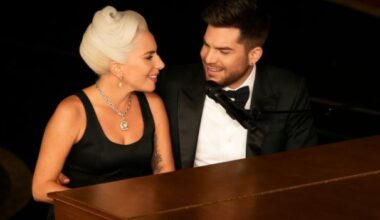
“Sometimes the only way to survive this world… is to let the music break you open.” — Adam Lambert whispered, his voice shaking, just moments before the unimaginable unfolded. There were no bright lights. No backup dancers. Just Adam Lambert, Lady Gaga, and a piano beneath a single spotlight—two icons standing in the hush of vulnerability. When Adam sang the first trembling notes of “Shallow”, his voice cracked with something deeper than sound: grief, gratitude, and raw humanity. Gaga reached for his hand mid-verse, her eyes wet, her harmony not flawless but real—the kind of real that stops time. The audience didn’t cheer. They didn’t dare. A thick, tearful silence wrapped the room. For four minutes, no one moved. And in the wings, Bradley Cooper—who once performed this very song with Gaga—stood frozen, his eyes red, hands clenched over his mouth. When the final note faded, he was seen whispering to a friend: “That wasn’t a cover. That was a resurrection.” This wasn’t just music. It was memory. It was love. It was a moment that no one who witnessed it will ever forget.

Adam Lambert And Lady Gaga Deliver A Soul-Stirring Duet Of “Shallow” – A Moment Of Pure Magic When two vocal titans like Adam Lambert and Lady Gaga share the stage, the world holds its breath. But instead of going big and theatrical, the duo stunned fans with a tender, stripped-down performance of the emotional ballad “Shallow” – and it was nothing short of breathtaking. A Simpler Stage, A Deeper Impact Dressed in coordinated black and white, the pair radiated elegance and unity. Lady Gaga known for her bold, eccentric fashion – surprised the crowd with a sleek black gown and a classic updo, exuding timeless glamour. Beside her, Adam Lambert brought a touch of refined edge in a tailored white jacket and black trousers. As the lights dimmed and a single piano note rang out, the two stood facing each other — eyes locked, tension high — in front of a grand piano. Then, Lambert opened the song with the first haunting lines, his voice rich, vulnerable, and soaring. Gaga joined in softly, her voice delicate and raw. Together, their harmonies built layer by layer, each note filled with aching beauty. There was no need for pyrotechnics or choreography — the emotion in their voices was the entire show. As they reached the iconic crescendo…