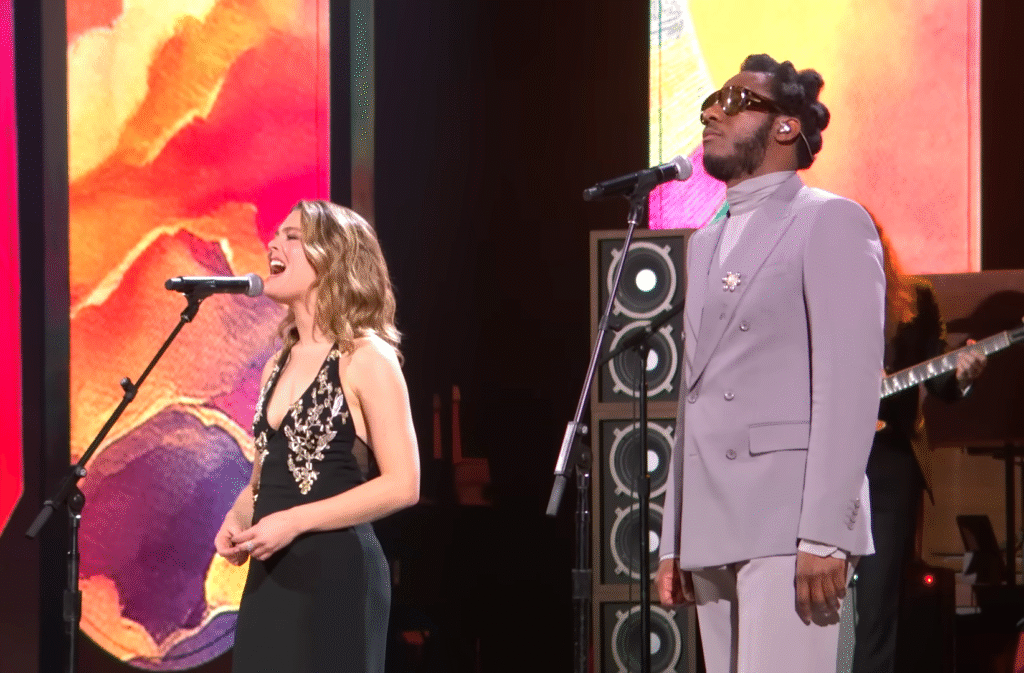
For the Grateful Dead’s Kennedy Center Honors, a moment of sublime musical alchemy unfolded when the timeless soul of Leon Bridges joined the earthy, effervescent energy of Maggie Rogers to reinterpret “Friend of the Devil.” The performance began in a hush, Rogers alone on a dimly lit stage, her fingers gently picking a melancholic pattern on an acoustic guitar, her voice a clear, vulnerable whisper that immediately cast a spell of intimate confession.

Then, like a warm breeze, Leon Bridges’ smooth, honeyed baritone floated in from off-stage, a perfect harmonic balm as he walked toward her, clad in a sharp, rust-colored suit.

They traded verses like old friends sharing a story, Rogers’ modern folk inflection beautifully contrasting with Bridges’ classic, soulful gravitas. The arrangement built gradually, a single pedal steel guitar crying softly in the background, as their voices entwined in gorgeous, close-harmony on the iconic chorus, transforming the Dead’s tale of a weary outlaw into a poignant and spiritual dialogue.

It wasn’t a replication but a reimagining—a respectful, soul-stirring conversation between two distinct artistic voices, united in celebrating a timeless song, culminating in a powerful, quiet grace that held the honored members and the entire audience in rapt, silent awe before erupting into grateful applause.

0 Shares:
Leave a Reply

Your email address will not be published. Required fields are marked *

You May Also Like
Read More

Lainey Wilson Looks Back on the Year That Was Hers, a Year of Dreams That Unfolded Like a Song She Was Born to Sing, While Wearing a Smile and a Cowboy Hat Tilted Just So. Every Milestone, From Standing Ovations to Chart-Topping Hits, Felt Like a Step Toward Something Greater and More Legendary. It Wasn’t Just the Accolades or the Fervent Audiences; It Was the Unwavering Belief That She Was Leaving Her Own Mark on the History of Country Music. As She Looks to the Future, She Can See Clearly That Lainey Wilson Isn’t Just Rising; She’s Here to Rule.

Lainey Wilson discovers that the little things give her a sense of groundedness. “I’m making sure that I…
Read More

Neil Young stood beneath the spotlight, older now, but stripped raw by emotion. For the first time in over four decades, he sang “My Boy” live—a song he wrote for his son, born with a disability. His voice cracked. His hands shook. But the words flowed like a father’s prayer through time. This wasn’t a performance—it was a homecoming of the heart. As he whispered, “You’d better take your time,” the room fell silent. No lights. No cheers. Just tears. It was the sound of memory. Of pain. Of love that never gave up. And in that fragile moment, Neil wasn’t a legend. He was just a dad, still trying to hold on to a boy the world made grow up too soon.

“You’d Better Take Your Time”: Neil Young’s Shattering Return to ‘My Boy’ After 40 Years The room held…