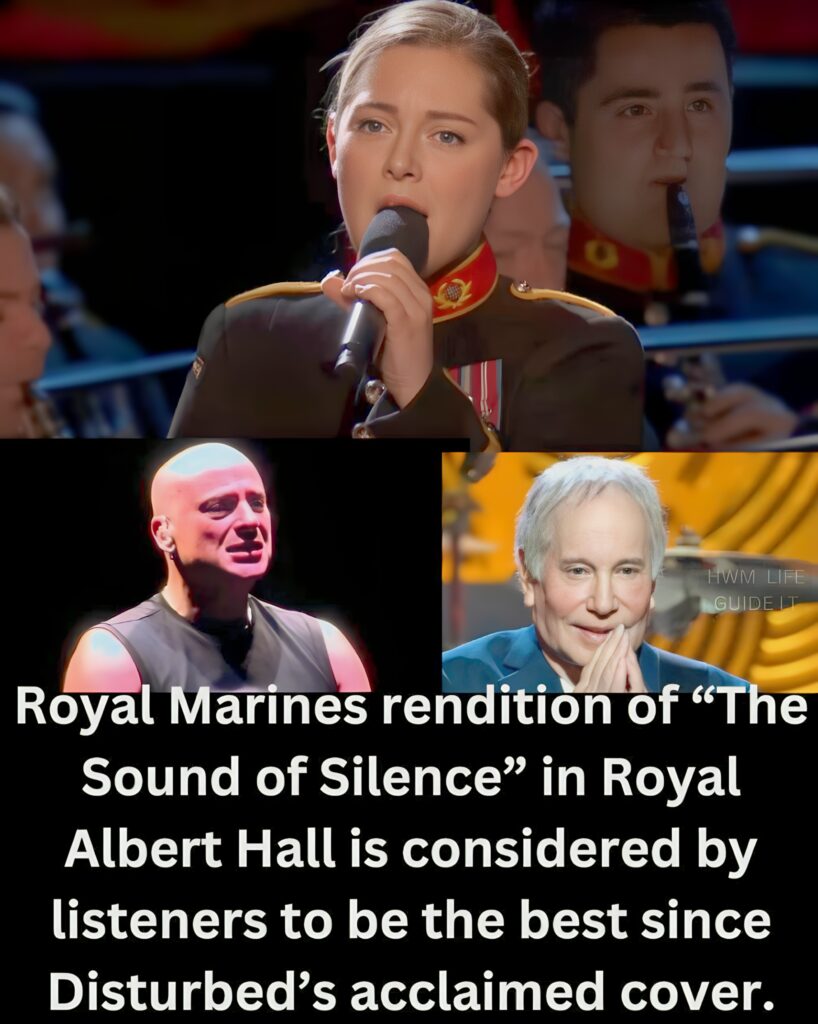
During the 2020 Mountbatten Festival of Music at London’s Royal Albert Hall, the lights dimmed until only a lone spotlight illuminated Band Lance Corporal Sam McIndoe clutching a clarinet. A charged hush fell over the hall as the full orchestra of the Bands of HM Royal Marines eased into Paul Simon’s mournful opening melody. That first, breath-soft phrase seemed to erase the thousand-strong audience, leaving just woodwinds and memory suspended in the domed, velvet air.
Although “The Sound of Silence” began life as a 1960s folk ballad, this arrangement leans heavily on post-millennial drama, clearly inspired by the song’s arena-sized renaissance after Disturbed’s 2015 cover. McIndoe’s clarinet traces the original vocal line while French horns layer minor-mode harmonies that swell and recede like distant surf. The effect is simultaneously reverent and cinematic, proving a military band can pivot from marches to pop elegies without losing polish.
Strings—yes, Royal Marines musicians double on strings—enter next, sketching a glacial crescendo that passes seamlessly to a battery of muted trumpets. Flutes flutter just above the brass like gulls on a harbor breeze. At the midpoint, the corps of drums drops in a heartbeat-steady cadence on side-drums, transforming the piece from introspective lament to solemn military tribute.
That blend of precision and emotion springs from one of the world’s toughest dual-discipline training pipelines. Every musician here survived fifteen weeks of Royal Marine Commando basic training before entering the Royal Marines School of Music, where they spent up to three years mastering harmony, orchestration, and drill. The result is a corps that can evacuate casualties one month and sight-read Mahler the next.
Historically, Royal Marines bands served aboard Royal Navy ships, providing both morale and medical assistance during the world wars. More than two hundred musicians died in action by 1945—a higher proportion than any other service branch. Echoes of that sacrifice reverberate through this performance; when the low brass intones the bridge’s descending line, it feels like a whispered roll-call for fallen comrades.
The Mountbatten Festival itself is steeped in naval heritage, named after Admiral of the Fleet Lord Louis Mountbatten. Proceeds support service charities, meaning every ticket funds rehabilitation programs for veterans and scholarships for bereaved families. In that context, the choice of “The Sound of Silence” becomes pointed: a meditation on unheard voices given literal resonance by servicemen in dress blues.
Earlier in the evening, a short film on mental-health resilience played on massive LED screens, introducing the song as a reflection on the silent struggles many personnel face after deployments. When the orchestra finally reached the famous “people talking without speaking” motif, you could sense listeners connecting lyrics to lived experience—an emotional ambush delivered without a single spoken word onstage.
Mid-piece, the Corps of Drums steps forward, their white-belts gleaming under house lights. Snare rolls swell into thunderous flourishes, then retreat to pinpoint rim taps that mimic the song’s ticking-clock tension. Buglers echo the main melody in tight sixths, and for a heartbeat the hall feels as big as an open parade ground under starlight.
Audience reaction was immediate and visceral. Gasps turned to tears, then to applause so sustained the conductor had to raise both hands in gentle plea for quiet before the coda. Within hours, performance clips rocketed across YouTube, cracking a million views, their comment sections full of veterans thanking the band for “speaking my silence aloud.”
Older concertgoers recalled wartime broadcasts, while Gen-Z viewers compared the Marines’ austere delivery to viral cinematic renditions by Pentatonix and Disturbed. Somehow the arrangement satisfied both camps: nostalgia for classic harmonies paired with the atmospheric heft demanded by modern ears raised on blockbuster soundtracks.
Unlike Simon & Garfunkel’s fragile acoustic original—or Disturbed’s guttural power ballad—this version embraces spacious orchestration. The clarinet’s reedy lament contrasts with velvet brass chords, and a sudden pianissimo rest leaves the hall breathless before percussion snaps the pulse back to life. Silence isn’t absence here; it’s another instrument, wielded with exacting skill.
Royal Albert Hall’s legendary acoustics magnify every nuance. Even a solitary triangle ping ripples to the highest balcony. From the conductor’s rostrum, strategic pauses allow natural reverberation to bloom, creating the illusion of vast, unseen choirs joining the Marines’ ranks. It’s a masterclass in using space as sound.
Ironically, a song once adopted by anti-war protesters now finds powerful voice in a military ensemble. Rather than contradicting its origins, the setting reframes the piece as dialogue: service personnel performing an anthem about listening to unheard cries. The message feels especially poignant in an era when mental-health conversations break decades-old taboos.
Beyond gala stages, the Royal Marines Band Service tours schools, hospitals, and remote garrisons, using music to bridge gaps where politics falters. Their repertoire spans Holst to Beyoncé, yet “The Sound of Silence” remains a set-list fixture, requested everywhere from Caribbean disaster-relief zones to NATO ceremonies in Estonia. Each rendition carries whispers of that first Albert Hall hush.
As the final chord faded into the venue’s domed ceiling, the conductor lowered his baton, and uniformed musicians held position until every echo died. Then came an eruption—foot-stomps, cheers, medal ribbons clinking against tunic buttons. In that thunderous gratitude lay the performance’s true legacy: a reminder that even the most disciplined soldiers wield art not as escape, but as a louder way to tell truths silence can’t contain