Cryin’ in Harmony: Steven Tyler and Liv Tyler Reunite Through Song and Soul
Some fathers give their daughters lullabies. Steven Tyler gave his daughter Liv Tyler a power ballad—and a lifetime of questions. But when they finally stood on stage together under soft lights and softer hearts, it became one of the most unexpectedly emotional moments in rock history.
From Silence to Spotlight
Liv Tyler didn’t grow up knowing Steven was her father. She only discovered the truth at age 11, after years of wondering why she resembled Mia Tyler, Steven’s other daughter. The revelation came suddenly, in a phone call from her mother, Bebe Buell, who delicately explained that the rock star she’d been told was “just a friend” was actually her father.
“I felt like someone had rewritten my whole life in a single phone call,” Liv later recalled. Yet there was also relief—a name to attach to the emotions she had felt all her childhood. The real work of fatherhood, however, would come years later, when the two slowly began to build a relationship.
While Liv became a Hollywood star—gracing the big screen in Armageddon and The Lord of the Rings—music remained an invisible string connecting father and daughter. Especially one song: I Don’t Want to Miss a Thing.
Originally written for the Armageddon soundtrack—where Liv played the lead—Steven Tyler recorded the Aerosmith anthem with raw emotion, watching scenes of his daughter on screen as he sang.
“That was the hardest vocal I’ve ever recorded,” Steven confessed. “I wasn’t just singing a love song. I was singing as a father, watching his daughter go through hell. It gutted me.” Few fans realized that the iconic power ballad was as much a father’s confession as it was a love song to a fictional character.
The Reunion Performance That Shook the Room
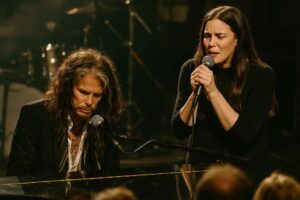
Years later, at a Rock Hall tribute in 2019, the duo shared the stage for the first time publicly. Liv walked out, dressed in simple black, gripping a microphone with hands that trembled visibly. Steven was already at the piano, tears glistening in his eyes before a single note played.
What happened next wasn’t flashy. No pyrotechnics. No screaming guitars. Just a father and daughter, trading verses to the song that had unknowingly defined their bond.
Liv’s voice—soft, untrained, and full of sincerity—wove around Steven’s weathered tenor as they sang the chorus:
“I just wanna hold you close,
Feel your heart so close to mine…”
The audience didn’t cheer. They didn’t clap. They breathed with them. Because what they were witnessing wasn’t a duet—it was healing, a reconciliation made visible through music.
Behind the scenes, a small detail had nearly gone unnoticed: Steven had asked the stage crew to dim the lights even further, creating a cocoon of intimacy. “I wanted it to feel like it was just us, like no one else existed in that moment,” he admitted later. And indeed, for those minutes, the room disappeared—leaving only father, daughter, and song.
Beyond Bloodlines: A Bond Forged in Melody
As the final notes faded, Steven leaned over and pulled Liv into a long, trembling hug. “She saved me,” he whispered into the microphone. “Not by singing. Just by being my daughter. And letting me love her.”
Liv would later reveal that the performance wasn’t rehearsed. “I was terrified,” she admitted. “But we’ve spent so much time apart, emotionally. I just wanted to stand next to him and let him know I’m here.”
Fans online hailed it as one of the most tender moments in rock history. The performance wasn’t about perfect harmonies or vocal technique—it was about forgiveness, recognition, and love painstakingly earned over years of separation.
Adding another twist few knew, Steven had once confided in a crew member that he had nearly canceled the duet the night before. He feared the emotions would overwhelm him, turning the stage into a breakdown rather than a performance. “I was scared I’d ruin it,” he admitted quietly. But when father and daughter finally locked eyes during the chorus, the fear dissolved into music, raw and unfiltered.

A Legacy Rekindled
The performance went viral almost instantly, inspiring tributes, fan art, remixes, and even a surge in streams for I Don’t Want to Miss a Thing. But beyond the numbers, it altered the public’s perception of Steven Tyler—not just a rock god, but a father learning, late in life, how to show up for his child one lyric at a time.
Nearly two decades after Liv discovered her father’s identity, and years after Armageddon, that single moment on stage proved that some songs aren’t just hits—they’re lifelines. The Tyers’ duet was more than music; it was a reminder that love, even when delayed, can echo louder than any arena applause.
For Steven and Liv, the ballad that had defined a film now defined a family. And for anyone fortunate enough to witness it, it was proof that sometimes the greatest power ballads aren’t about heartbreak—they’re about forgiveness, reconnection, and the extraordinary, quiet courage it takes to love.