PAUL McCARTNEY RESPONDS TO NOEL GALLAGHER’S CLAIM THAT OASIS WERE ‘BIGGER’ THAN THE BEATLES
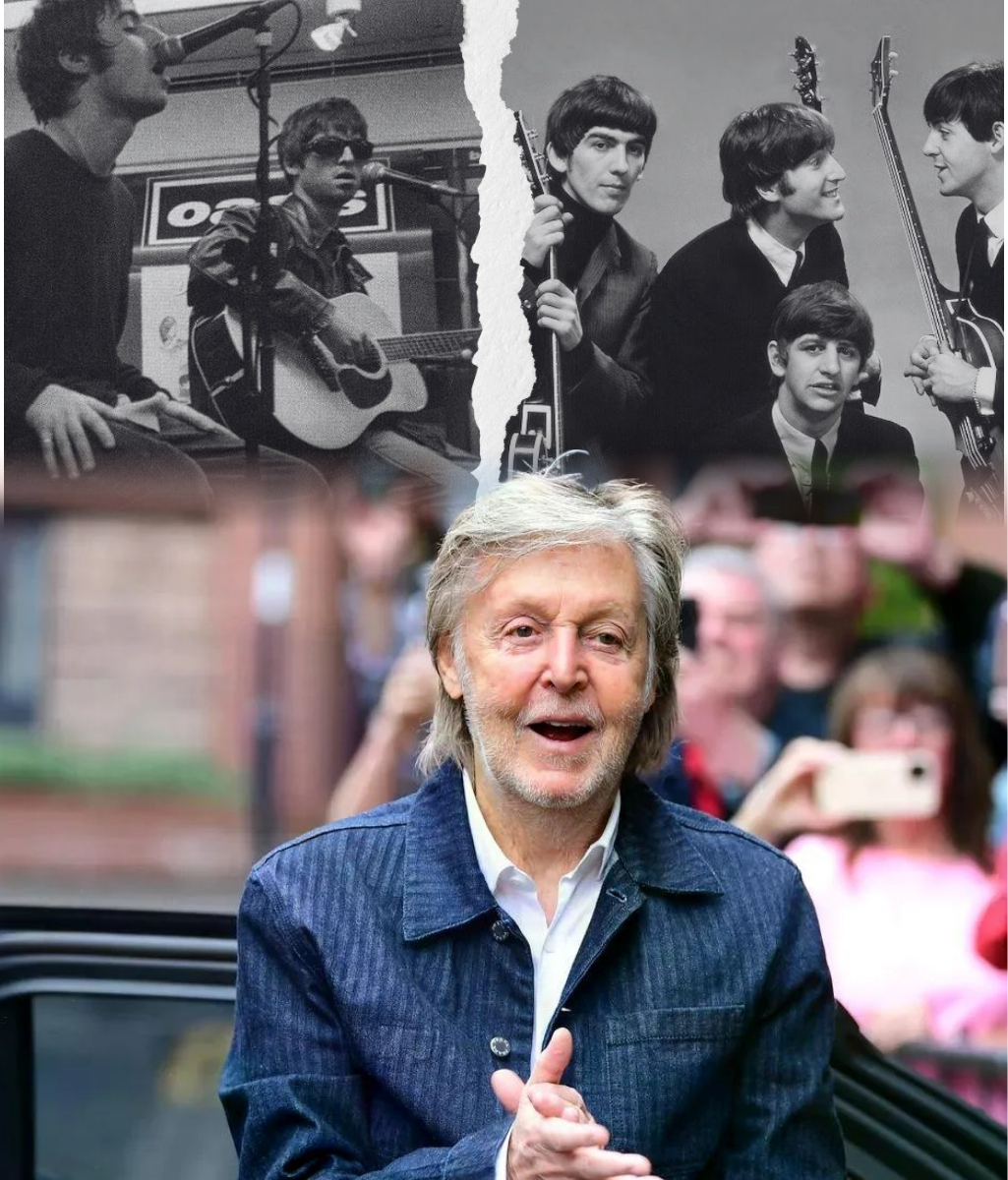
It was one of the most infamous boasts in British rock history. In the mid-1990s, at the height of Britpop, Noel Gallagher of Oasis declared with characteristic swagger that his band was “bigger than The Beatles.” The comment, amplified by headlines across the UK, seemed less a statement of fact than a challenge thrown across generations — daring the surviving Beatle to respond.
For years, fans speculated about what Paul McCartney really thought. Now, looking back with the calm of a man who has weathered countless comparisons, Paul has spoken with the mixture of wit and grace that has long defined him. “I remember when Oasis said it,” McCartney reflected in an interview. “And I thought, well, it’s kind of the kiss of death, isn’t it? You don’t say that. The minute you do, someone will be waiting to prove you wrong.”
He wasn’t cruel, nor dismissive. In fact, McCartney went on to praise the Gallagher brothers’ talent. “They were a great band,” he said. “The songs, the attitude — it was exciting. They gave British music a real kick at the time.” But he added with a smile, “We had a pretty good run ourselves, and I think history’s shown where it all landed.”
The Beatles’ legacy, stretching from “Love Me Do” in 1962 to Abbey Road in 1969, remains a cultural landmark. Decades later, their catalog continues to sell, their influence still woven into the DNA of modern music. Oasis, with their anthems “Wonderwall” and “Don’t Look Back in Anger,” captured a generation and briefly defined the spirit of the 1990s — but their reign was shorter, marked by brilliance as well as volatility.
McCartney’s response carries the wisdom of someone who has learned not to measure greatness by sales, headlines, or bravado. “Every band has its moment,” he mused. “And that’s how it should be. But to be bigger than The Beatles? That’s not really the point, is it? The point is to make your mark while you can.”
For Noel Gallagher, the comment has long followed him, often cited with a mixture of amusement and embarrassment. Even he has admitted over the years that perhaps it wasn’t the wisest thing to say. Yet in McCartney’s telling, it becomes less a jab than a cautionary tale — the reminder that music is not a competition but a continuum.
As Paul leaned back, recalling the noise and bravado of the Britpop years, his smile widened. “I always thought Oasis were good lads,” he said. “But bigger than The Beatles? Well… maybe in their own heads.”
The room filled with laughter, not ridicule. It was the laughter of a man secure in his place in history, one who doesn’t need to defend his legacy because it speaks for itself every time another needle drops on Let It Be or Hey Jude.
And so, McCartney’s response was not anger, nor dismissal, but the gentle humor of someone who knows the truth: The Beatles were never just a band to outsize or outshine — they were, and remain, the measure by which music itself is judged.