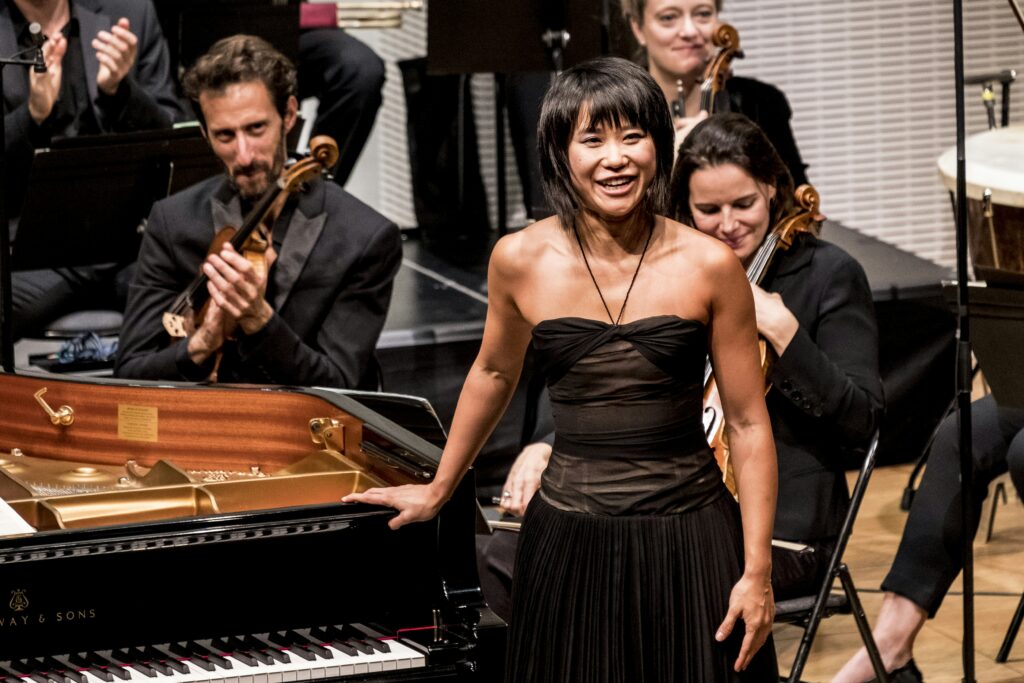
The hall went silent as the spotlight fell on a single grand piano. No orchestra, no elaborate staging—just two figures sitting shoulder to shoulder. Yuja Wang, the dazzling virtuoso often known for her fiery performances, and Víkingur Ólafsson, the Icelandic pianist hailed as the “Glenn Gould of our century.” What followed was not merely a concert, but something closer to a revelation: Schubert’s Fantasy for Piano Four Hands, D.940, reborn.
From the very first notes, it no longer felt like two pianists but one voice, one heartbeat. Written in 1828, mere months before Schubert’s death, the piece is often read as a farewell letter—achingly intimate, filled with longing and the shadow of mortality. In the hands of Yuja and Víkingur, it was transformed into a dialogue of opposites: fire and ice, tempest and stillness, colliding and then dissolving into harmony.
Sitting so close they nearly brushed shoulders, their hands crossed, collided, and retreated in perfect choreography. It wasn’t just technique—it was trust. Each seemed to breathe in rhythm with the other, surrendering and reclaiming phrases as if bound by an invisible thread. The audience wasn’t simply hearing Schubert; they were witnessing the raw anatomy of human connection being written, erased, and rewritten in real time.

What astonished many was the reversal of roles. Yuja Wang, famed for her explosive virtuosity and theatrical flair, suddenly pared herself down to something achingly restrained—each note cut like glass, every silence trembling with meaning. Meanwhile, Ólafsson, often celebrated for his meditative minimalism, seemed freer, more daring, as though her fire had awakened an undiscovered boldness in him. They challenged and seduced one another across the keyboard, until the line between where one ended and the other began completely dissolved.
Schubert once called the Fantasy a “song without words,” perhaps written for Karoline Esterházy, the woman he quietly adored. But here, it became larger than that—an allegory for every human bond. Friendship, love, sacrifice, vulnerability: all of it flickered through the shifting harmonies. There were moments where one pianist held the storm at bay while the other soared, and others where they locked into the same pulse, like two halves of a single breath.
When the final Allegro Molto Moderato came to its hushed conclusion, time itself seemed to pause. For a few suspended seconds, the hall was frozen—no coughs, no shuffling, no applause. Just the silence of hundreds of hearts refusing to break the spell. Then came the eruption, a wave of applause crashing forward. Yet Yuja and Víkingur did not leap up or bask in the ovation. They simply exchanged a glance—a knowing smile—that said more than words ever could: they had not just played together; they had lived inside the same soul for half an hour.
In an era where classical music is often packaged for spectacle, this performance was a reminder of something purer. A single piano. Two human beings. And one masterpiece that refuses to die, as long as artists like these are brave enough to give themselves over to it completely.
That night, Schubert’s farewell became not a relic of the past but a living heartbeat in the present. And Yuja Wang and Víkingur Ólafsson didn’t just perform it—they became it.