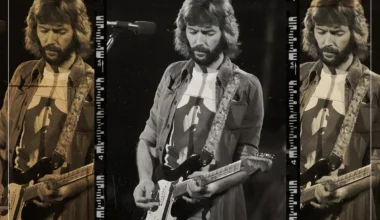
Brian May is one of the most innovative guitarists out there; he was always looking for exciting new ways to push himself as a creative.
For instance, when he first decided that he wanted to be an electric guitar player, he couldn’t actually play anything because his family couldn’t afford to buy him a six-string, so as an innovator, he decided to think of a unique way around his problem, which meant building his own electric guitar, which perfectly suited his playing style. “I was 17, and my dad was a great electronics engineer and a craftsman, so me and my dad set about making a guitar,” he recalled. “I couldn’t afford a Stratocaster or a Gibson or whatever, so we thought, ‘We can make a guitar, and maybe we can make something that’s better than anyone’s ever made’… My dad had that attitude, which I inherit: if a thing’s worth doing, it’s worth doing properly.”
It was using this guitar that May managed to put together some of the greatest rock music to come out of the 1970s and ‘80s. Queen worked together exceptionally as a unit, but there is no escaping the fact that they wouldn’t be celebrated as such to ever take to the stage were it not for the emotive playing style of Brian May.
While he had a lot of influences, the main thing that Brian May was looking for with his guitar work was emotion. When you have a singer with the range of Freddie Mercury, this is easier said than done. He had such a dynamic voice and could embody every feeling under the sun with it, so much so that any attempt at an emotive guitar solo would often pale in comparison. This meant May had to champion melody and harmony throughout his guitar solos; he didn’t want to just do general shredding like a lot of rock guitarists were at the time, but instead gave listeners a melodic line with different parts that they could follow along.
Jeff Beck was a big inspiration when it came to perfecting this kind of playing style. May always loved the way that his instrumental songs felt as though they had a natural progression. There was never any interest in soloing for the sake of it, he could tap into something beautiful within listeners through the power of his fretwork alone.
“If you wanna hear his depth of emotion, sound and phrasing, and the way he could touch your soul, listen to ‘Where Were You’ of the Guitar Shop album… sit down and listen to it for four minutes,” said May. “It’s unbelievable; it’s possibly the most beautiful bit of guitar music ever recorded, alongside Jimi Hendrix’s ‘Little Wing’. So sensitive, so beautiful, so incredibly creative and unlike anything you’ve ever heard anywhere else.”
May could embed this style of playing into a lot of his music, but the song where he really perfected it was ‘Killer Queen’. He himself has admitted that this is one of his greatest solos because it was when he really learnt to strike that balance between shredding, melody and harmony. There are plenty of other solos where he does this, but ‘Killer Queen’ opened the door, it was proof of concept and is still one of the greatest that the Queen guitarist ever wrote. Was it his absolute best? Well, May certainly thinks so.
“The ‘Killer Queen’ solo was the first time I really managed to get the harmony thing across, and all those harmonies move about, they’re not just following each other parallel – they all interact like a small jazz band would do,” he said.
Concluding, “With ‘Killer Queen’, it worked out so nice. I would probably put that forward as the one that perhaps I would want people to remember me by.”