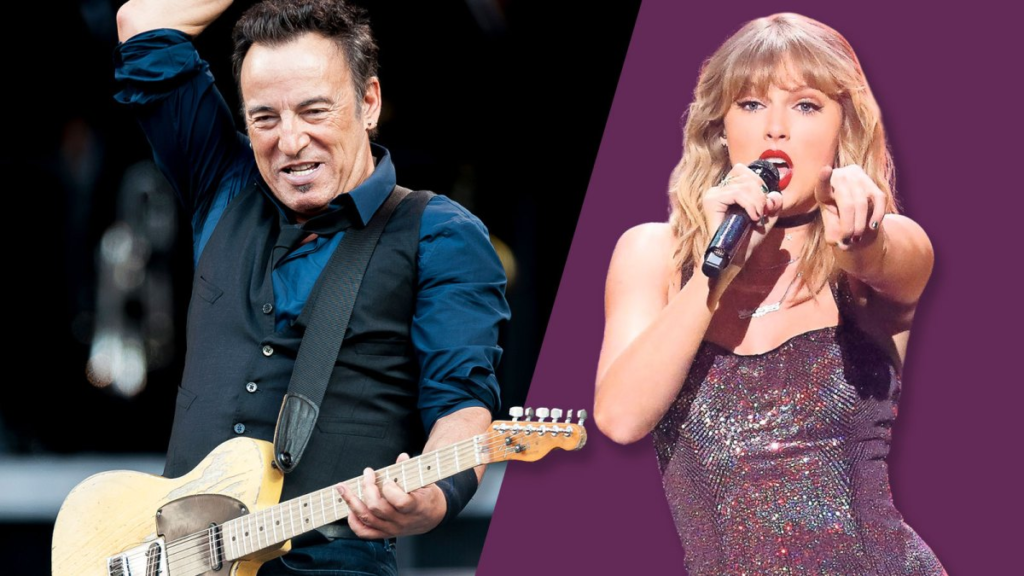
In the high-stakes arena where music meets the machinery of power, the American Federation of Musicians (AFM) has just drawn a line in the sand. It is a moment that feels less like a standard industry press release and more like a protective shield held over two of the world’s most influential artists. As Bruce Springsteen finds himself in the crosshairs of a political firestorm—one fueled by a direct attack from former President Donald Trump—the union has stepped forward with a defiant message of solidarity, encompassing both the “Boss” and Taylor Swift in a shared defense of artistic freedom.
The spark for this latest cultural earthquake was struck on a Wednesday night in Manchester, England. Far from the shores of his home state, Springsteen stood before a sold-out crowd of thousands and chose to speak from the heart about the shifting landscape of the United States. With the cameras rolling and the house lights dimmed, the man who has spent fifty years documenting the American soul didn’t hold back.
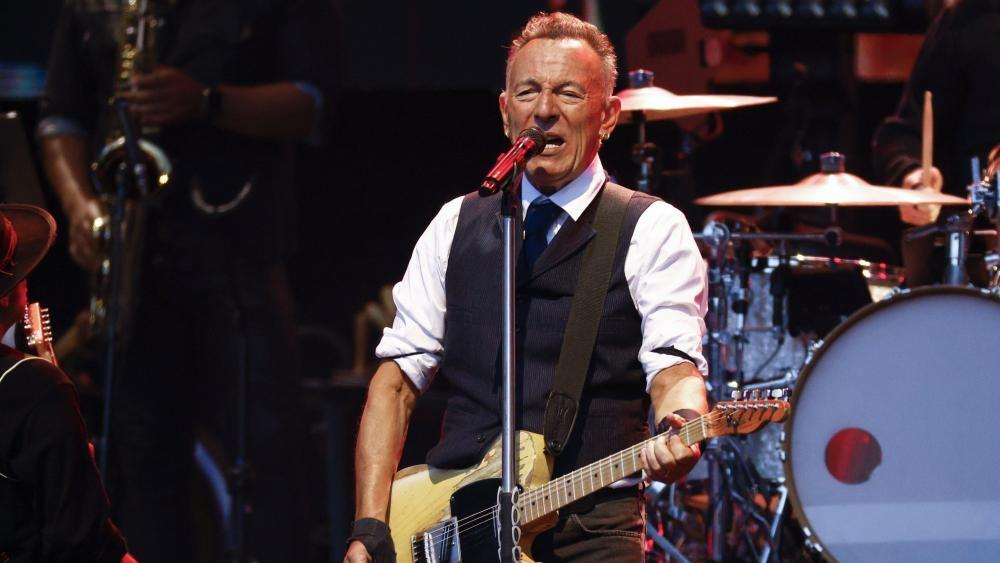
A Message from Manchester
Springsteen’s declaration was a searing critique of the current state of the “American experiment.” He spoke of an America that has served as a beacon of hope for two and a half centuries, but warned that it had fallen into the hands of an administration he labeled as “corrupt, incompetent, and treasonous.” From the stage, he called upon those who still believe in the ideals of democracy to rise up and raise their voices against the tide of authoritarianism.
The speech, which was quickly uploaded to YouTube and his official website, went deeper than a mere political endorsement. Springsteen touched on the systemic pain being inflicted on American workers and the rolling back of civil rights legislation that once promised a more pluralistic nation. He spoke of a shift in global alliances, accusing the current leadership of turning its back on historical allies in favor of siding with dictators.
The Digital Retaliation
As the footage of the Manchester set went viral, the response from the political world was swift and aggressive. Donald Trump took to his social media platform to launch a personal tirade against the rock legend. He dismissed Springsteen as “highly overrated” and painted him as a “pushy, obnoxious jerk” driven by “radical left politics.” In the same breath, he pivoted to an attack on Joe Biden, labeling him the “worst ever” and “mentally incompetent.”
However, the attempt to isolate and discredit Springsteen was met with an immediate counter-offensive from the American Federation of Musicians. The union’s public statement was an uncompromising defense of the right to speak truth to power. By explicitly naming both Springsteen and Taylor Swift—who has navigated her own relentless gauntlet of political vitriol—the AFM made it clear that they view these attacks as a form of intimidation designed to silence the creative community.
Beyond the Billboard Charts
The union’s message was simple: artists like Springsteen and Swift are the embodiment of American values, representing the courage and compassion required to engage in the democratic process. The AFM’s stance suggests that when a musician’s platform is used to fight for justice, it isn’t just “entertainment”—it is a vital, protected exercise of freedom of expression.
In a modern era where speaking out can carry heavy professional and personal costs, this unified front between the icons and their union represents something larger than music culture. It is a battle for the soul of the country, a reminder that the songs we sing and the voices we raise are often the final line of defense for the democracy we share. As long as the union stands with the artists, the music remains a powerful, unshakeable force for change.