When Bruce Springsteen Talks Politics, Even His Critics Can’t Change the Station
There’s a reason they call him The Boss.
It’s not just the decades of sold-out stadiums, the marathon concerts that stretch past midnight, or the Grammy Awards collecting dust on a shelf somewhere in New Jersey. It’s something harder to define — a raw, unshakeable sense of conviction that has threaded itself through every song, every lyric, every three-hour show Bruce Springsteen has ever delivered.
And lately, that same conviction has found a different kind of stage.
In a statement that spread across social media faster than a needle hitting vinyl, Springsteen had this to say about former President Donald Trump:
“I couldn’t care less what he thinks about me. He’s the living personification of what the 25th Amendment and impeachment were for. If Congress had any guts, he’d be consigned to the trash heap of history.”
No hedging. No PR softening. Pure, unfiltered Springsteen — and the internet has been buzzing ever since.
🎵 More Than a Musician — A Cultural Compass
To understand why these words landed so hard, you first have to understand who Bruce Springsteen really is.
For casual listeners, he might be the guy behind Born to Run or Dancing in the Dark — stadium anthems built for open windows and summer highways. But for the millions who have followed his career across five decades, Springsteen represents something far deeper than chart-topping hits.
He is, in many ways, the musical conscience of working-class America.
From the gritty streets of Asbury Park to the haunting imagery of The Ghost of Tom Joad, his storytelling has always gravitated toward the people who are often overlooked — factory workers, veterans, the quietly struggling, the quietly hopeful. His characters don’t live in penthouses; they live on front porches, in pickup trucks, in towns that the rest of the country tends to forget.
That authenticity is precisely what gives his voice weight when it steps outside the boundaries of music. When Springsteen speaks, people on both sides of the political aisle take notice — because even those who disagree with him know he isn’t performing. He means every word.
🎤 Reading Between the Lyrics
So what exactly is Springsteen saying, and why does it matter beyond a headline?
His reference to the 25th Amendment and impeachment isn’t casual political name-dropping. These are specific constitutional tools — mechanisms built into the foundation of American governance precisely to deal with extraordinary failures of leadership.
The 25th Amendment allows for the removal of a president deemed unfit or incapacitated to serve. Impeachment is the process through which a president can be formally charged with misconduct by Congress. By invoking both, Springsteen isn’t simply venting frustration. He’s making a deliberate, constitutional argument — one that frames his critique not as celebrity opinion, but as civic principle.
His sharp jab at Congress — implying that its members lacked the courage to act when it counted — adds another layer to the statement. It suggests that his frustration isn’t limited to one individual, but extends to an entire system that he believes looked the other way when accountability was most needed.
It’s the kind of observation that could have come straight out of a Springsteen song — a system that fails the very people it was built to protect. Only this time, it came from a press statement instead of a recording studio.
🔥 The Crowd Is Divided — And Loud
True to form for anything connected to Trump or Springsteen, the reaction has been anything but quiet.
On one side, fans and supporters have rallied around his comments, celebrating them as an act of moral clarity in a political climate that often rewards vagueness. To them, Springsteen is doing what great artists have always done — using their platform to speak uncomfortable truths, to hold a mirror up to power and refuse to look away.
There’s a long, proud tradition of that in rock and roll. From Bob Dylan’s protest anthems to Neil Young’s political broadsides, musicians have always found ways to weave civic conscience into their art. Springsteen, in that context, is simply playing his part in a much older song.
On the other side, critics have pushed back hard. Some argue that celebrities — no matter how beloved or culturally significant — shouldn’t wield their fame as a political weapon. Others have called his language unnecessarily aggressive, the kind of rhetoric that deepens wounds rather than healing them. A portion of his own fan base, who might share his love for heartland rock but not his political views, have expressed disappointment, even betrayal.
Social media, predictably, has become the venue for all of it. Clips of the quote have ricocheted across platforms, landing in comment sections that range from passionate agreement to fierce condemnation — and everywhere in between.
🌎 The Bigger Question Nobody Can Quite Answer
Springsteen’s statement has also reignited a conversation that doesn’t seem to be fading anytime soon: How much political influence should artists have?
It’s a genuinely complicated question, and not one with a clean answer.
On one hand, musicians and artists have historically been among the most effective voices for social change. Think of how powerfully music shaped the civil rights movement, the anti-war protests of the Vietnam era, or the AIDS awareness campaigns of the 1980s. Artists reach people that politicians often can’t — through emotion, through story, through melody.
They can walk into a room of 70,000 people and make every single one of them feel understood. That’s a kind of influence that no campaign ad or policy speech can quite replicate.
On the other hand, fame and insight are not the same thing. Being beloved does not automatically confer political wisdom. And when celebrities wade into the deep waters of governance and constitutional law, it’s fair to ask whether their platforms are amplifying important conversations — or simply making the noise louder.
Springsteen, it should be said, is not a newcomer to this territory. He has spent decades engaging with political and social themes, both in his music and in his public life. This is not a musician suddenly discovering politics in his later years; it is a man who has been paying close attention for a very long time.
📖 A Story That Started Long Before This Statement
To view this moment in isolation would be to misread it entirely.
Springsteen has been speaking out on political matters since long before it was fashionable — or controversial — for rock stars to do so. He has endorsed presidential candidates, campaigned for causes, and positioned himself repeatedly on the side of what he calls “the America that lives in its ideals rather than its fears.”
His music tells the same story. Born in the U.S.A. — often misread as a patriotic anthem — is actually a searing critique of how Vietnam veterans were abandoned by the country they served. The Rising, written in the aftermath of September 11th, became an anthem of grief, resilience, and communal healing. American Skin (41 Shots) tackled police violence years before that conversation dominated the national stage.
In each case, he took a risk. In each case, he leaned into the discomfort rather than retreating from it.
His latest comments, then, are less a departure and more a continuation — another verse in a very long song he’s been writing his whole life.
🎶 When the Music Meets the Moment
There’s something worth noticing about the way Springsteen speaks — because it echoes the way he writes songs.
His statement isn’t carefully crafted political language designed to minimize backlash. It’s direct. It’s emotional. It’s built for impact rather than diplomacy. In that sense, it sounds less like a press release and more like a bridge in a Springsteen track — the part where the restraint breaks down and the raw feeling finally surfaces.
That quality is exactly what makes it powerful — and exactly what makes it polarizing.
Raw language cuts through. It gets attention, makes headlines, and forces a reaction. But it can also harden positions, close off dialogue, and give critics easy ammunition. In a media landscape already saturated with outrage and tribalism, strong words can sometimes generate more heat than light.
Springsteen has always understood this tension better than most. His best songs hold that duality — the anger and the hope, the accusation and the compassion — in the same breath. Whether his political statements can achieve the same balance is, perhaps, a harder thing to pull off outside of a song.
🌟 What This Moment Actually Reveals
Step back far enough, and Springsteen’s comments become less about any single individual and more about something much larger.
They are a reflection of a cultural moment in which the line between artistic expression and political engagement has all but disappeared. A moment in which silence itself is seen as a statement. A moment in which artists are increasingly expected — by their audiences, by the media, by history — to take sides.
For music fans in particular, this raises fascinating questions about the relationship between art and its creator. Can you separate the music from the man? Does it matter if you agree with him? Does it change how Born to Run sounds on a Friday night?
For many, the answer is no. The music lives its own life, independent of the person who made it. But for others, an artist’s beliefs and their work are inseparable — each illuminating the other.
Springsteen, for better or worse, has never tried to keep those two things apart.
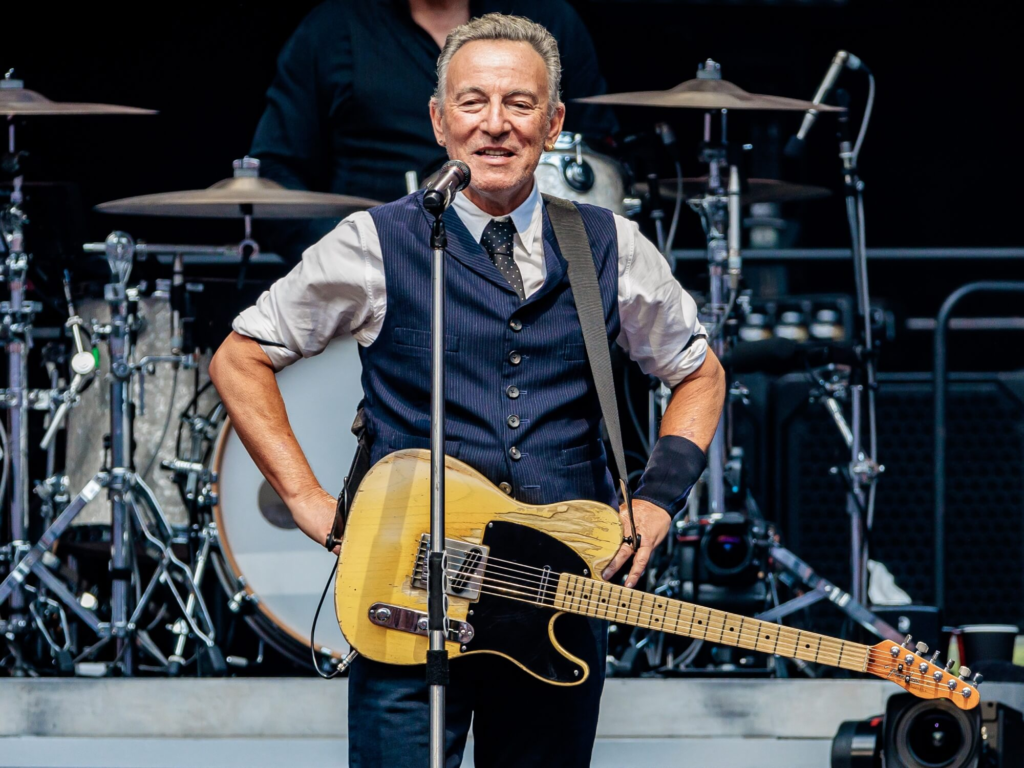
🎸 The Stage Is Still His
As the conversation continues to evolve — as it will, in comment sections and talk shows and kitchen table arguments across the country — one thing remains undeniably true.
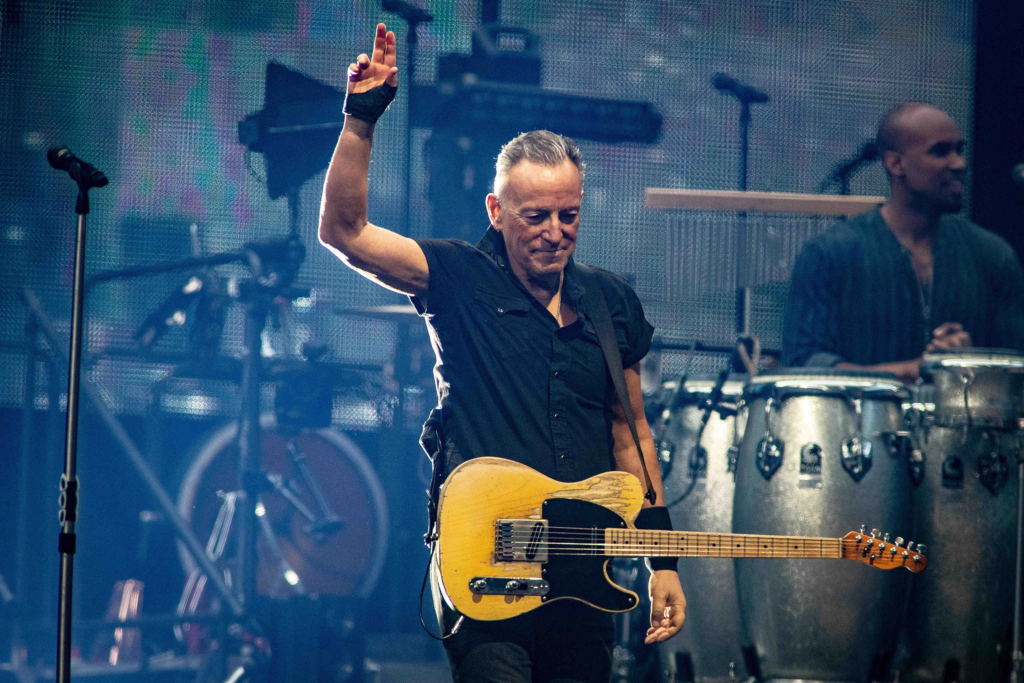
Bruce Springsteen still knows how to fill a room.
Whether the room is a stadium in New Jersey, a recording booth in New York, or the unpredictable, chaotic arena of public opinion — he knows how to make people feel something. Agreement, outrage, pride, discomfort — it doesn’t always matter which. What matters is that the feeling is real.
And in an age when so much of what we consume has been polished and processed into near-total meaninglessness, that might just be the most rock and roll thing of all.
His words have done what his music has always done — sparked something. Where that spark leads, and what it ultimately lights up, is now in the hands of the audience.
And the audience, as always, has plenty to say.
💬 What do you think — should artists like Springsteen use their platform to speak out on political issues? Or should the music do the talking? Drop your thoughts below.