One of the very first live performances Ed Sheeran ever gave took place in a familiar, understated setting: the gym at Thomas Mills High School in Suffolk. He was just an eleven-year-old kid with a guitar, playing a modest charity concert to help raise money for Red Nose Day.
Fourteen years later, standing in the middle of a sprawling West African slum, the global superstar felt as though his life had come entirely full circle.
Sheeran traveled to Liberia as part of a dedicated field visit for Comic Relief. Almost immediately after his plane touched down on the tarmac, he found himself walking into West Point—the largest, most densely populated, and arguably most dangerous slum neighborhood in Liberia’s capital city of Monrovia.
Before embarking on the journey, the singer-songwriter had made a strict personal vow to look past the typical grim headlines. He wanted to focus heavily on the positive aspects of the community, aiming to highlight the progressive, hopeful strides the country was making to rebuild itself.
The Suffocating Reality of West Point
Within minutes of crossing into the perimeter of the township, Sheeran realized just how incredibly difficult keeping that promise was going to be.
The first thing that confronted him was the heavy, inescapable stench rising from a sewage-soaked pathway that serves as the main artery into the community. Following a local social worker down a labyrinth of cramped, narrow alleys choked with rotting food and household litter, the passages became so tight that it was nearly impossible to walk through without physically brushing against the fragile shacks jammed into every single inch of available space. With the midday temperature soaring toward 30°C (86°F), the air felt thick and entirely suffocating.
Everywhere he looked, human beings were navigating their lives in conditions of extreme squalor. Local guides informed him that an estimated 75,000 residents are packed into the area, completely cut off from running water or basic sanitation infrastructure.
Just when the musician thought the reality couldn’t get any more severe, the social worker accompanying him delivered a jarring piece of context: the children currently living inside those terrible shacks were actually considered the fortunate ones.
Meeting JD: A Childhood Lost to the Streets
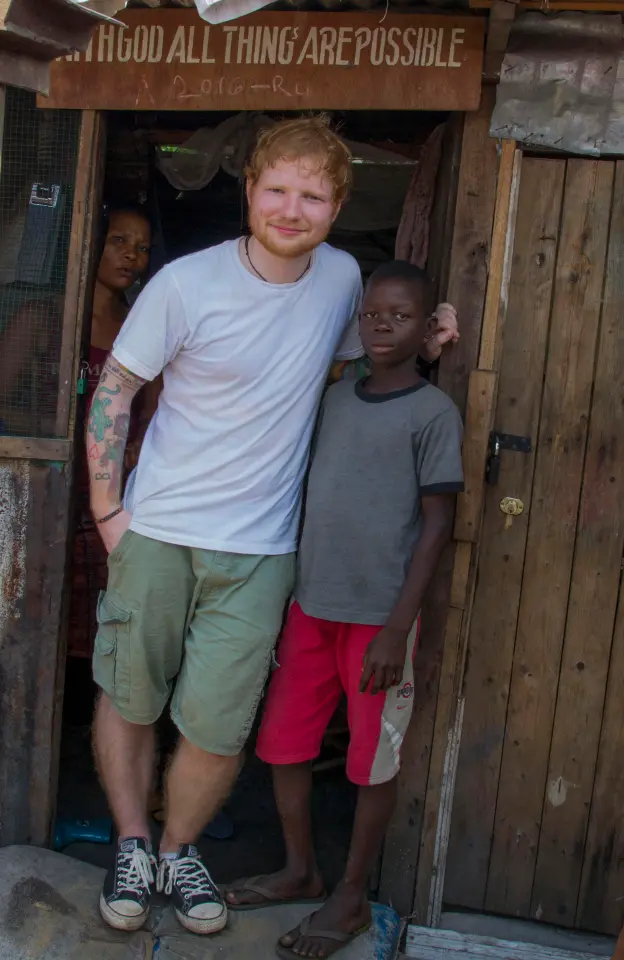
It felt entirely impossible to comprehend how anyone in West Point could be deemed “lucky”—until Sheeran was introduced to a young boy named JD.
Standing quietly in the only set of clothes he owned, the boy kept his eyes fixed firmly on the dirt as introductions were made. He stated that he was sixteen years old, but his physical frame was tiny; he barely possessed the stature of a ten- or eleven-year-old. The social workers noted that street children in Monrovia frequently inflate their age, believing it is safer to project an aura of maturity and experience to survive the elements.
JD was distant, answering questions with a quiet, hollow reservation. When he eventually looked up, his eyes revealed absolutely no trace of childhood happiness.
The tragic trajectory of JD’s life is a stark reflection of the region’s recent history. His father had abandoned the family when he was just an infant, and his mother lost her life during the devastating regional Ebola outbreak. He was subsequently brought to the capital by an aunt, but she abandoned him on the streets six months prior. He had been entirely on his own ever since.
To keep himself alive, the young boy spends every single day washing dishes for vendors in the local market. His daily earnings are just enough to purchase a cup of clean drinking water and a single slice of bread—which constitutes his entire food source for twenty-four hours. On fortunate mornings, he is able to scavenge for discarded fish scraps when the local fishing boats return to the shoreline. These, he quietly explained, are his good days.
The weight of the boy’s daily existence hit the musician with immense force. Like most people, Sheeran had always possessed an abstract understanding that global poverty existed, but witnessing it first-hand made him realize he had absolutely no concept of what true systemic poverty actually meant.
The Children of the Shoreline
JD is far from an isolated case. More than 14,000 children, some as young as seven years old, are currently living and working on the volatile streets of Monrovia. The aftermath of the Ebola crisis severely compounded the crisis, forcing an influx of newly orphaned children to migrate to the capital to fend for themselves after losing their entire support systems.
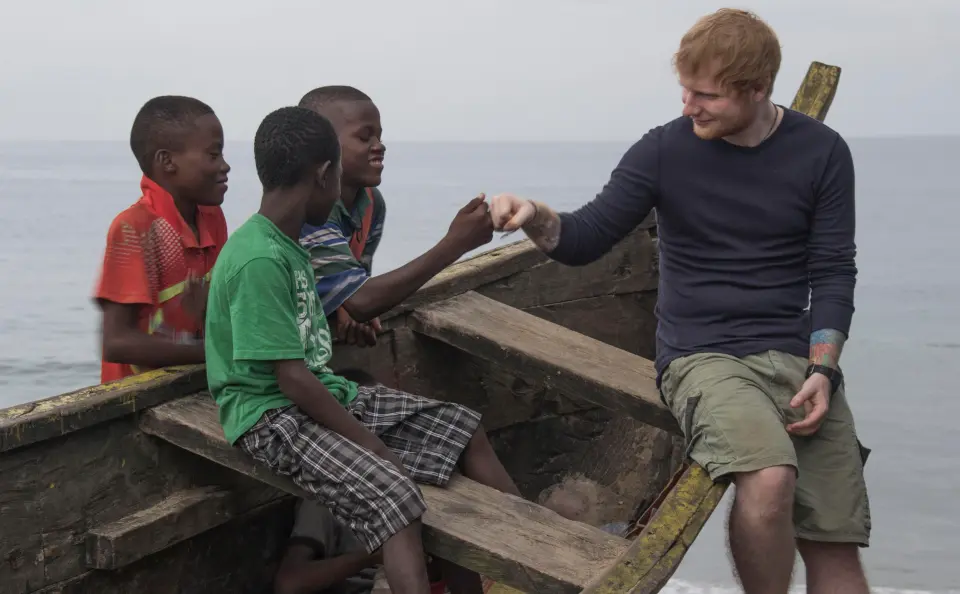
In the early hours of his second morning in the country, Sheeran walked out onto the local beach and was completely stunned by the sight before him: dozens of tiny, sleeping bodies scattered across the dirty sand, resting directly among piles of washed-up garbage. It felt completely surreal.
Searching the shoreline, he located JD. The boy was curled up asleep inside the hull of an old wooden canoe. He had no pillow, no blanket, and was wearing the exact same clothes from the day before—now completely soaking wet from a heavy downpour that had moved through the area overnight.
Looking at the sleeping child, Sheeran found himself torn between profound shock that children are forced to endure such conditions, and a rising sense of personal guilt knowing that as soon as the cameras stopped rolling, he had a ticket to fly home.
Attempting to articulate the scene for the documentary crew, the artist found himself entirely breathless, staring out at the beach in absolute disbelief. Ultimately, the words failed him entirely.
Nothing in his life as a touring musician could have prepared him for the raw shock of seeing little kids bedding down amidst human waste and refuse. It was completely heartbreaking, and the emotional weight proved too heavy to contain. Despite trying his best to hold his composure for the broadcast, the sheer gravity of the situation completely overwhelmed him.
The Path to Education and Safety
However, amidst the profound bleakness of the shoreline, systemic efforts are actively working to alter these narratives. An organization known as Street Child Liberia utilizes funds raised through Comic Relief to actively seek out and identify homeless youth like JD. Their primary mission is to safely reunite these displaced children with distant relatives or foster families.
Crucially, donations have helped establish the Street Corner Education initiative, which provides a structured, safe environment for street kids to learn.
The mere mention of the word “school” brought the very first hint of a genuine smile to JD’s face in three days. He was desperate to learn. Ironically, an active school building sat just a hundred yards away from the stretch of sand where he slept every night, but without a home, stable clothing, or reliable food, it might as well have been on an entirely different continent. Despite lacking the most basic human necessities, the one thing this little boy wanted most in the world was an education. He viewed a classroom as his solitary ticket out of the slums.
The fragile moment of optimism quickly dissipated as a group of older boys arrived on the beach, hovering in the background and watching the film crew closely. Violence and systemic exploitation are a constant threat for street kids, and looking closer, Sheeran noticed that JD’s young face already carried the physical scars of street altercations.
The atmosphere on the beach felt inherently unsafe, even for an adult production crew, let alone an unprotected child navigating the night entirely alone. It was harrowing enough to contemplate a child hunting for a slice of bread each morning, but the realization that these kids have to constantly worry about being awoken in the dark by a knife in their face brought a chilling perspective to the visit.
A Direct, Measurable Difference
The encouraging reality of the initiative is that changing these lives is entirely achievable. It costs roughly £45 to provide a child living on the streets of Liberia with the tuition, supplies, and uniforms required to attend school for an entire year.
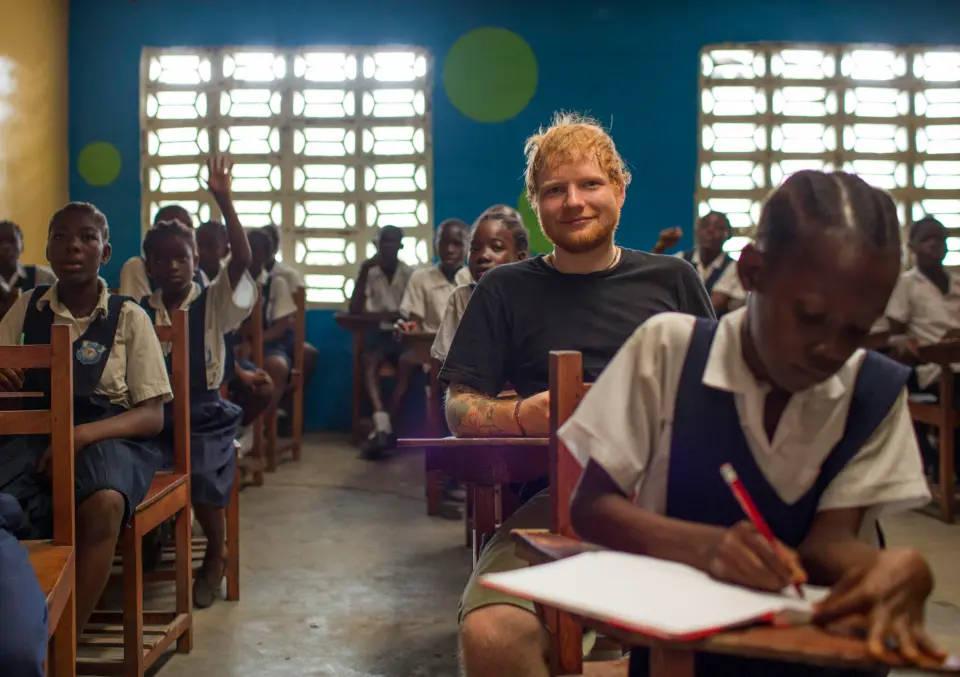
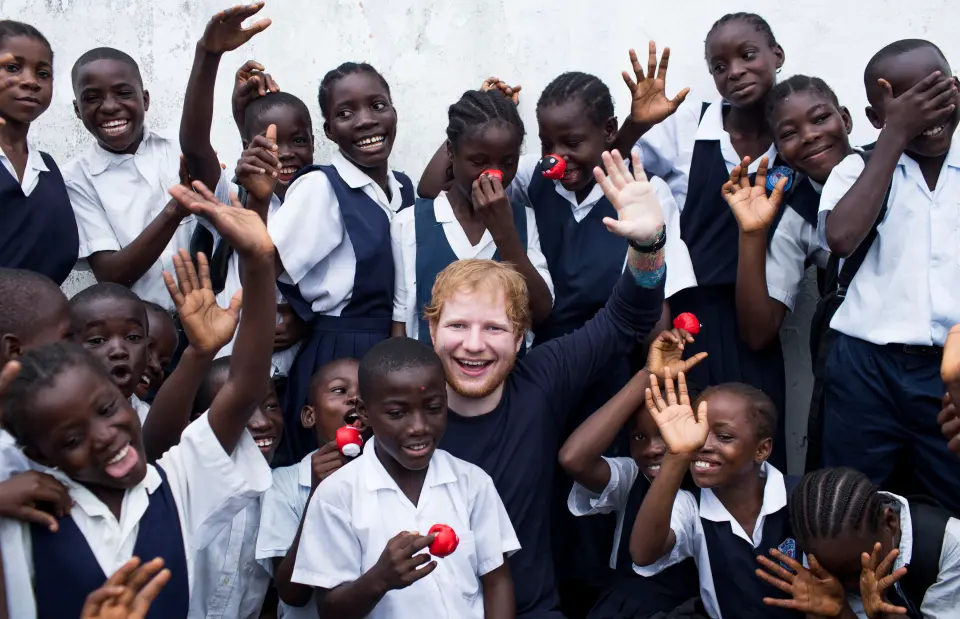
Later in the trip, Sheeran had the opportunity to meet some of the children who had successfully transitioned off the streets through the program. Because of the public’s contributions to Comic Relief, these kids had been securely reunited with family members or placed in supervised group homes.
Seeing them in clean uniforms, holding schoolbooks, and interacting with passionate teachers revealed a completely different side of Monrovia. They were behaving exactly as children should—playing games, laughing hysterically with classmates, and simply being silly.
The most profound takeaway from the journey was observing the massive, life-altering impact that a relatively small amount of financial aid can make in a community like West Point. Reflecting back on his eleven-year-old self performing in that high school gym, Sheeran realized that the £30 or £40 his schoolmates had raised decades ago held far more power than he ever could have imagined as a child.
It is an old sentiment, but as families tuck their children into warm, safe beds tonight, it is worth remembering the thousands of kids who are currently setting up camp inside wooden boats, beneath concrete bridges, and on top of municipal refuse heaps. Their daily lives are an ongoing struggle for survival, but strategic collective action remains a proven tool to help rewrite their futures.
Seeing how a simple baseline of £45 can completely alter the course of a child’s life in communities like West Point, do you think global charity initiatives should place a greater emphasis on funding localized educational access rather than general emergency aid?