Some cities become famous for their skylines. Others are remembered for industry, politics, or history. But there are certain places whose identity is forever shaped by the people they gave to the world—and Birmingham is undeniably one of them.
From its working-class neighborhoods, factory streets, and industrial heart emerged a voice that would eventually help redefine rock music forever. Ozzy Osbourne did not simply come from Birmingham; he carried the spirit of the city with him throughout his entire career. No matter how global his fame became, there was always something unmistakably tied to where he started—something grounded, raw, and real.
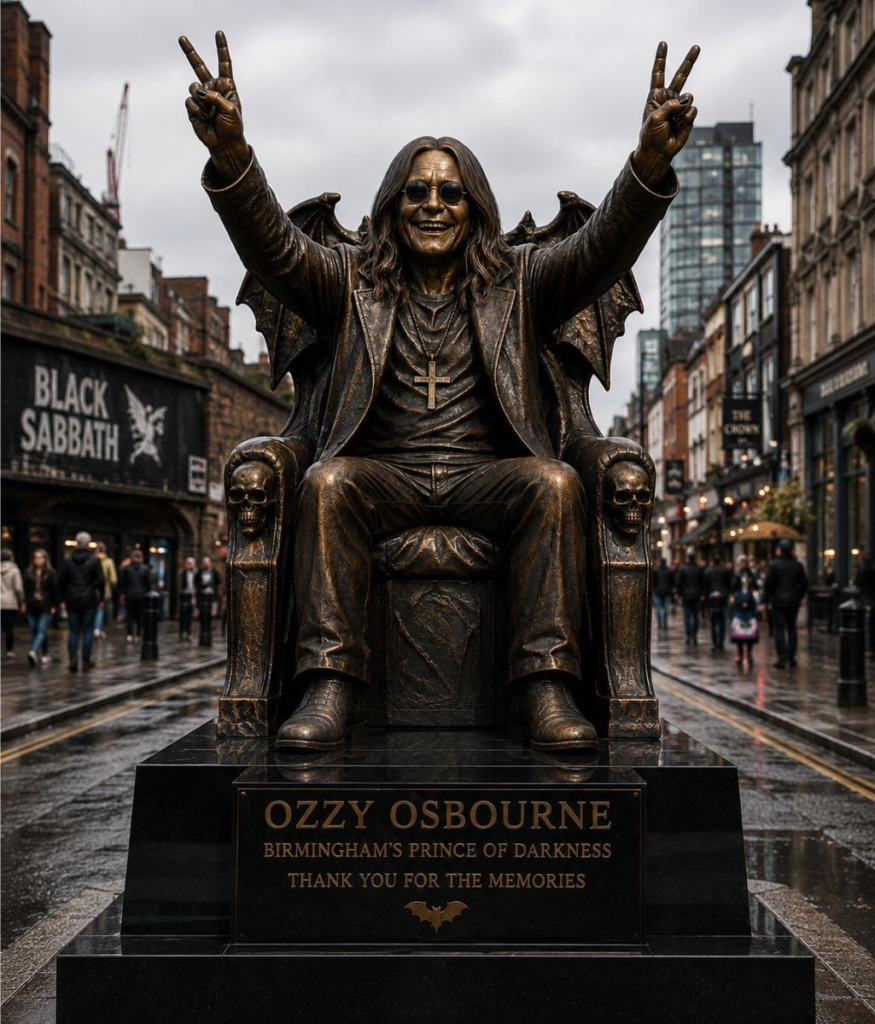
Now, years later, that connection between artist and hometown is being revisited in a deeply meaningful way.
Not through a new album.
Not through another concert tour.
But through a growing question that continues to gain quiet momentum among fans, local communities, and music lovers around the world:
Should Birmingham create a permanent tribute to Ozzy Osbourne?
For many people, this conversation is about far more than recognition alone. It is about preserving presence. Music may travel endlessly across generations and continents, but physical landmarks carry a different kind of emotional power. They give memory a place to live. They allow future generations to stand in front of something tangible and understand that history happened there—not only through stories, but through space itself.
Across the United Kingdom, statues and landmarks honor artists, writers, leaders, and cultural figures who helped shape national identity. Yet for many longtime fans, the idea that Birmingham still lacks a permanent, highly visible tribute to Ozzy has begun to feel increasingly surprising.
The requests themselves are not extravagant.
Fans are not demanding massive monuments or grand spectacles.
What they want feels much simpler—and perhaps more meaningful because of that simplicity.
A bronze statue.
A memorial landmark.
A dedicated public space that quietly says:
He came from here.
And those four words carry enormous weight.

Because Ozzy’s story has never been only about fame or success. It represents transformation. It is the story of someone raised in ordinary surroundings who went on to influence millions of listeners across the world, while never fully losing the connection to the city that shaped him.
That kind of legacy belongs not only to the artist, but also to the place that helped create him.
That is why this movement feels different from the usual conversations surrounding celebrity tributes. There is nothing especially loud or performative about it. Instead, support continues to grow steadily, driven by a shared feeling among fans that some cultural legacies deserve to exist not only in music collections and streaming platforms, but also in physical places people can visit, experience, and remember.
In many ways, Birmingham itself sits at the center of that emotional connection.
The same streets that once looked ordinary to the people living there eventually became the birthplace of heavy metal. The city’s industrial atmosphere, working-class grit, and harsh realities helped shape the sound and attitude that Ozzy and Black Sabbath would later bring to the world. For countless fans, separating Ozzy’s story from Birmingham’s identity feels almost impossible.
And perhaps that is why the idea of a permanent tribute resonates so strongly.
It is not simply about celebrating a musician.
It is about recognizing a chapter of the city’s own cultural history.

A statue or memorial would not only honor Ozzy Osbourne as an individual artist—it would acknowledge Birmingham’s role in shaping one of the most influential movements in rock music history. It would become a place where longtime fans, younger generations, tourists, and music lovers alike could reflect on how one local voice grew into a global phenomenon.
As discussions continue, one thing already feels clear to many supporters:
The debate is no longer centered on whether Ozzy deserves the recognition.
For most fans, that answer has long been settled.
The real question now is whether Birmingham is ready to transform decades of musical legacy into something permanent—something future generations can stand beside in the very city where it all began.
Because while songs continue to echo through speakers around the world, places matter too.
And sometimes, the most lasting tribute is giving a legacy a home people can return to again and again.