Bob Dylan Joins The Rolling Stones for Once-in-a-Lifetime Performance of “Like a Rolling Stone” in Rio
It was a humid night in Rio de Janeiro in April 1998, but nothing could have prepared fans at Praça da Apoteose for the seismic moment about to unfold. Midway through The Rolling Stones’ explosive set on their Bridges to Babylon world tour, the crowd suddenly erupted—not for Mick Jagger’s moves or Keith Richards’ riffs, but for the arrival of a legend stepping into a legend’s spotlight.

Bob Dylan, the very man behind the song that gave the Stones one of their most iconic live covers, walked onstage with a quiet presence that belied the power of what was about to happen.
“We’d like to do a song we wrote… no, that Bob Dylan wrote for us,” Jagger teased, flashing a grin. And then, it began.
Dylan, often aloof and minimalist in performance, leaned into the energy of the stadium-sized crowd. His voice was gravelly but charged with meaning. Jagger played the part of sidekick rather than showman, stepping back to let Dylan lead. Keith Richards and Ron Wood filled the space with raw guitar interplay, while Charlie Watts kept the whole thing grounded in rhythmic authority.

For a few minutes, rock and folk collided—not as separate genres, but as a unified force. The band played “Like a Rolling Stone” with a reverence that made the moment feel more like a coronation than a concert.
The audience, a sea of more than 50,000, seemed stunned into silence at first. But by the final chorus, they were screaming along, not just singing a song, but witnessing a historic alliance that few thought they’d ever see.

After the show, fan sites exploded with praise. On message boards, fans called it “transcendent,” “goosebumps-inducing,” and “the kind of thing you tell your grandkids about.” One reviewer simply wrote, “Like a Rolling Stone again, but this time better.”
Though Dylan and the Stones have shared bills before, this particular night in Rio has gone down as one of the most haunting and iconic live performances of the 1990s—a snapshot of two giants of music standing side by side, trading verses on a song that has defined rebellion and identity for generations.
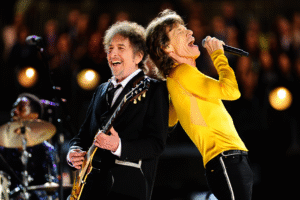
Years later, footage of the performance continues to circulate online, and every time it resurfaces, it reignites the same awe. It wasn’t just a duet. It was a moment when rock’s past and future stood together, harmonizing under the Brazilian sky