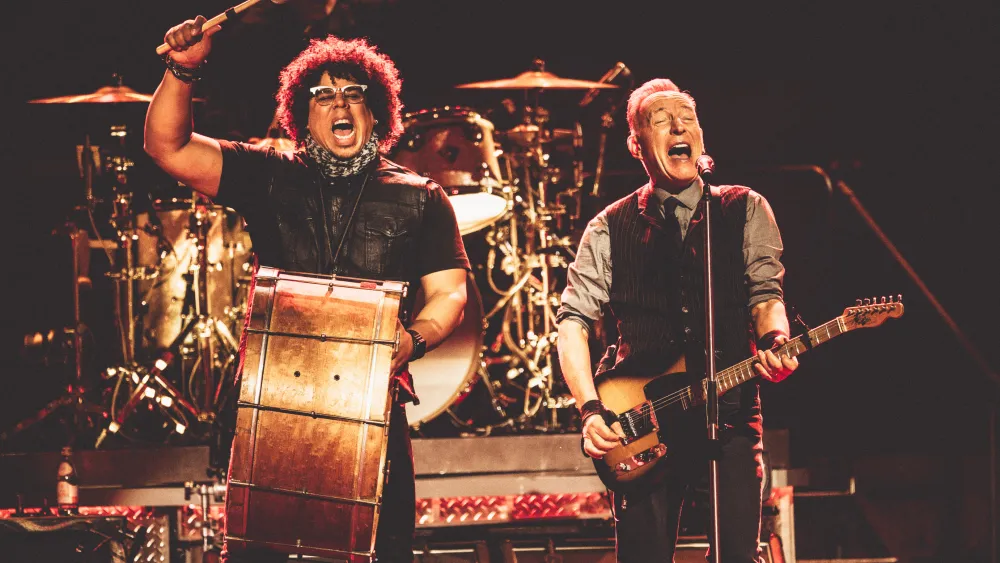
Some concerts entertain. Others stay with you long after the lights come up. And then there are nights like this—when Bruce Springsteen steps on stage and turns music into something larger, something that feels like it matters beyond the walls of an arena.
At the Kia Forum in Los Angeles, Springsteen and the E Street Band delivered a performance that moved between protest, memory, and a quiet but persistent call for unity. It wasn’t just a show—it felt like a reflection of the world outside, with all its fractures, tensions, and contradictions.
Because right now, the world does feel fractured. Injustice isn’t distant or abstract—it shows up in headlines, in cities, in communities, sometimes just down the street. And yet, in the middle of all that, there are still moments where something else breaks through. Moments where people gather, where voices rise together, where music becomes a way of making sense of things.
Springsteen has always lived in that space.
For more than 50 years, his songs have told stories about working lives, restless spirits, and the search for something better. But on this tour—Land of Hope and Dreams—those themes feel sharper, more direct. The political edge isn’t hidden between the lines anymore. It’s front and center.
The tour itself began in Minneapolis at the end of March, carrying with it the weight of recent events and a sense of purpose that followed the band to Los Angeles for their April shows at the Forum. By the time Springsteen walked on stage, there was already a feeling that this night would be different.
He didn’t ease into it.
Standing before the crowd, he spoke plainly about the ideals that have shaped his music for decades—democracy, freedom, and what he called “the sacred American promise.” But there was urgency in his voice too, a sense that those ideas were being tested. His words weren’t dressed up or softened. They landed directly, asking the audience to think, to listen, and to choose—hope over fear, unity over division, truth over noise.
And then the music took over.
Joined by the E Street Band—and with Tom Morello adding his unmistakable edge on guitar—the show surged forward with a raw, driving version of “War,” the 1969 protest song originally written by Norman Whitfield and Barrett Strong and made famous by Edwin Starr. It wasn’t just a cover—it felt like a statement, a bridge between eras where music and protest have always found each other.
Inside the arena, something shifted.
For a while, the outside world seemed to fall away. The crowd—around 17,500 people—was no longer just an audience. It became part of the experience, carried along by the rhythm, the volume, the shared sense of being present in something that felt meaningful. There was a kind of release in it, a temporary space where the noise of everything else quieted down.
Springsteen’s setlist moved carefully through that space, each song chosen with intention. Classics like “Born in the USA,” “Darkness on the Edge of Town,” and “Death to My Hometown” weren’t just nostalgia—they felt recontextualized, their themes echoing differently in the current moment. When he stretched the final notes of “toooooooowwwwwn,” it didn’t feel like a vocal flourish. It felt closer to something reflective, almost meditative.
He also returned to “American Skin (41 Shots),” a song that has long carried weight in conversations around justice and identity. Here, it landed with the same quiet intensity it always has—direct, unflinching, and impossible to ignore.
Between songs, Springsteen spoke again, touching on issues that stretched far beyond the stage—conflict overseas, the human cost of war, and the impact of shifting policies on vulnerable communities. It could have felt heavy. But instead, it created a sense of connection between the music and the world it reflects.
That balance—between urgency and hope—is what defined the night.
Because for all the directness, all the pointed commentary, the show never lost its sense of lift. The E Street Band played with the kind of chemistry that only comes from years on the road together, turning each song into something expansive and alive. The sound was big, unmistakably theirs—rooted in rock but stretching into something more communal, almost like a shared language between the stage and the crowd.
And through it all, there was still that feeling that has always been at the core of Springsteen’s work: the belief that people can come together, even when everything else feels uncertain.
By the time the night drew to a close, it hadn’t just been a concert. It had been an experience shaped by contrast—protest and celebration, tension and release, realism and optimism. A reminder that music doesn’t exist in isolation. It responds, it reflects, and sometimes, it brings people just a little closer to understanding each other.
As the final notes faded inside the Kia Forum, what lingered wasn’t just the sound of the band or the weight of the words. It was something quieter, but no less powerful—the sense that even in a complicated moment, there’s still room for connection, for reflection, and for hope.