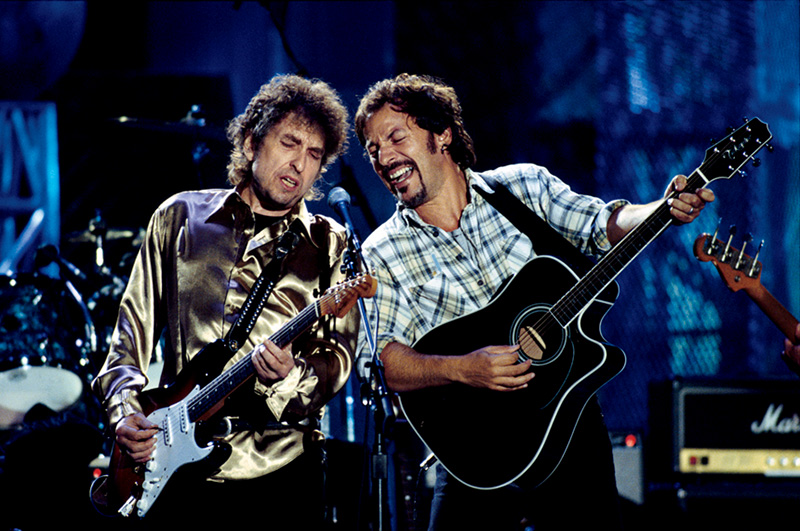
In the long, illustrious history of the Kennedy Center Honors, few moments have managed to pierce through the formal veneer of Washington, D.C., quite like the night in 1997 when the “Boss” stood before the “Bard.” It was an evening designed to celebrate the life’s work of Bob Dylan, but it was Bruce Springsteen who ensured the tribute would be carved into the soul of American cultural memory. He didn’t just play a song; he delivered a raw, reverent offering that felt less like a cover and more like a spiritual passing of the torch.
The setting was one of undeniable prestige, filled with the soft glow of tuxedos, evening gowns, and the heavy presence of the nation’s dignitaries. Yet, the moment Springsteen stepped out from the wings, the atmosphere underwent a chemical change. Dressed simply in black and bathed in a singular golden light, he brought a gritty stillness to the room. Armed with nothing but his guitar and the unmistakable rasp of his voice, he prepared to summon something ancient, urgent, and deeply necessary.
Reigniting the Anthem
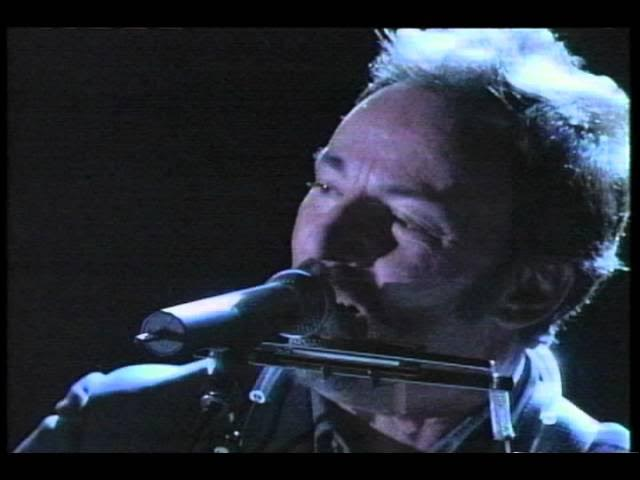
From the opening command of “Come gather ’round people wherever you roam,” it was clear that Springsteen wasn’t merely revisiting a 1964 classic. He was reigniting it. He conjured the spirit of a generation that had marched through the fire and fog of the sixties, but his delivery wasn’t trapped in nostalgia. Instead, his voice cut through the present day with a mixture of grit and grace. He made it feel as though the lyrics weren’t just a historical record of change, but a current demand for it.
As the verses progressed, the power players and cultural luminaries in the audience leaned in, visibly humbled by the weight of the performance. There were no theatrics to hide behind. The beauty of the moment lay in its seismic simplicity—Springsteen wasn’t interested in embellishing Dylan’s work; he was interested in excavating its truth. With every line delivered with quiet, bone-deep conviction, he stitched the struggles of the past to the challenges of the present. In that room, “The Times They Are A-Changin’” ceased to be Dylan’s song alone; it became a collective anthem for everyone in the room.
The Weight of Reverence
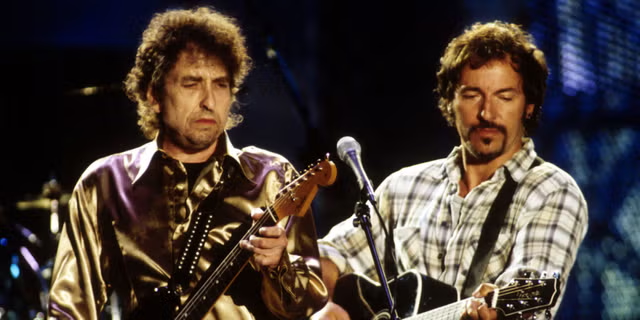
What allowed this tribute to transcend the typical award-show performance was the total absence of pretense. Springsteen didn’t try to reinvent Dylan or outshine the original composition. He acted as a vessel, letting the song speak through him with the clarity of a sharpened conscience. It was a testament to endurance, a bridge built on the foundation of shared empathy and lived experience.
From his seat in the balcony, Bob Dylan—the perpetually elusive and enigmatic poet—watched the performance with a rare, visible impact. He offered a small, knowing smile that carried more weight than a standing ovation. It was a silent acknowledgment that the pulse of his work was still beating, not as a museum piece, but as a living, breathing force.
A Spark for the Future
That night, Bruce Springsteen did more than just honor a fellow artist; he amplified a message. He reminded the world that songs of protest and purpose don’t have to gather dust on a shelf. Instead, they gather strength with time. He transformed a thirty-year-old rallying cry into something that felt vital and “alive in the now.”
As the final acoustic notes dissolved into the silence of the Kennedy Center, a spark remained. It was a reminder that as long as voices like Springsteen’s are willing to carry Dylan’s fire forward, the world will always find a reason to change, to strive, and to hope. The song may have ended, but the truth it carried stayed in the room long after the lights went down.