Some performances begin with applause. Others begin with anticipation. But every once in a while, a performance begins with a feeling that quietly settles over a room before a single lyric is sung.
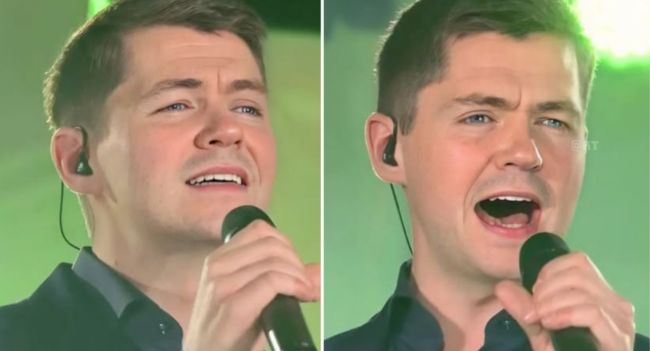
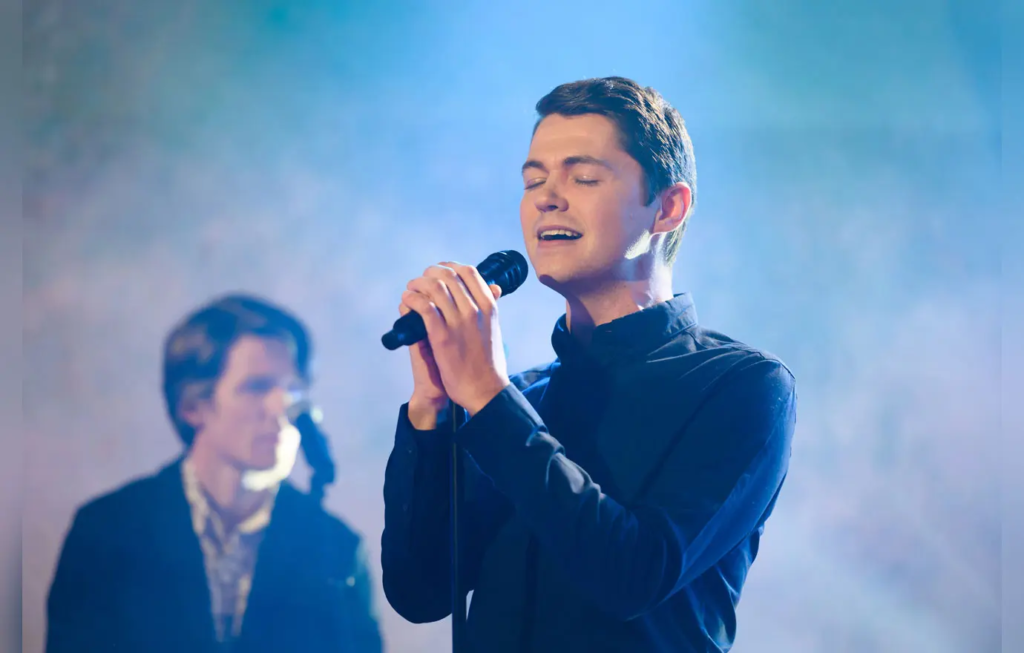
That was the atmosphere the moment Damian McGinty stepped forward during a Celtic Thunder performance of “The Green Fields of France.”
The energy in the venue shifted almost instantly. The lights dimmed into a softer glow, the movement across the stage slowed, and the audience—just moments earlier buzzing with excitement—fell into a silence so complete it felt almost fragile. It was not the silence of distraction or routine politeness. It was the silence of people sensing that the song they were about to hear deserved something deeper than casual attention.

Then Damian McGinty began to sing.
What made the moment so powerful was the restraint in the performance. Damian McGinty never tried to overpower the song or reshape it into something theatrical. Instead, he approached “The Green Fields of France” with quiet patience, allowing the story at the center of the lyrics to unfold naturally. His opening lines arrived gently, almost like a conversation spoken softly across generations.
The song itself has carried emotional weight for decades. Centered around the story of Willie McBride, a young soldier who never returned home from war, it asks the kinds of questions history often leaves unanswered. Was he frightened? Did he fully understand why he had been sent there? Did anyone stand beside him in his final moments?
Those questions have always lived inside the song, but hearing Damian McGinty deliver them gave them a renewed intimacy. Rather than sounding distant or historical, the lyrics suddenly felt immediate and personal, as though the audience was hearing them for the very first time.
Part of what gave the performance such emotional depth was the contrast within Damian McGinty’s voice itself. There was still a youthful brightness in his tone, yet he was singing about youth lost too soon. That tension became the emotional heartbeat of the performance. It no longer felt like a singer revisiting an old war ballad. It felt like one young man reaching across time to another.
Every lyric was delivered carefully, with space left between phrases for the audience to absorb the images carried inside the song. Damian McGinty never rushed through the story. He allowed listeners to picture the green fields, the weathered grave marker, the carved name in stone, and the unimaginable distance between a battlefield and the home that soldier never saw again.
Behind him, fellow Celtic Thunder members Emmet Cahill, Neil Byrne, and Ronan Scolard entered with harmonies that felt understated and deeply respectful. Their voices supported the performance without ever pulling focus away from its emotional core. The harmonies arrived softly, almost like quiet reassurance, adding warmth and gravity without disturbing the stillness that had settled over the room.
No one seemed interested in turning the song into a vocal showcase. That was part of what made the performance resonate so strongly. Celtic Thunder approached it not as entertainers trying to impress an audience, but as musicians sharing a memory together.
At one point, the atmosphere in the venue became so still that the performance no longer felt like a concert at all. It felt more like a room full of strangers collectively mourning someone they had never met.
As the song continued, the audience became inseparable from the moment unfolding onstage. There were no loud cheers breaking between verses, no distractions, no restless movement. People simply listened.
That silence became its own form of emotion.
In many live performances, applause is the sign that a song has connected. During “The Green Fields of France,” the connection revealed itself differently. It showed in the faces fixed toward the stage. It showed in the tears some audience members tried quietly to wipe away before the song had even ended. Most of all, it showed in the shared understanding spreading through the room—that some songs are not written simply to entertain. Some songs exist to help people remember.
By the final verse, Damian McGinty carried the full emotional weight of the story in his voice. It was not polished in a distant or overly perfect way. It sounded human. At times, it even sounded close to breaking. And that vulnerability gave the performance its power.
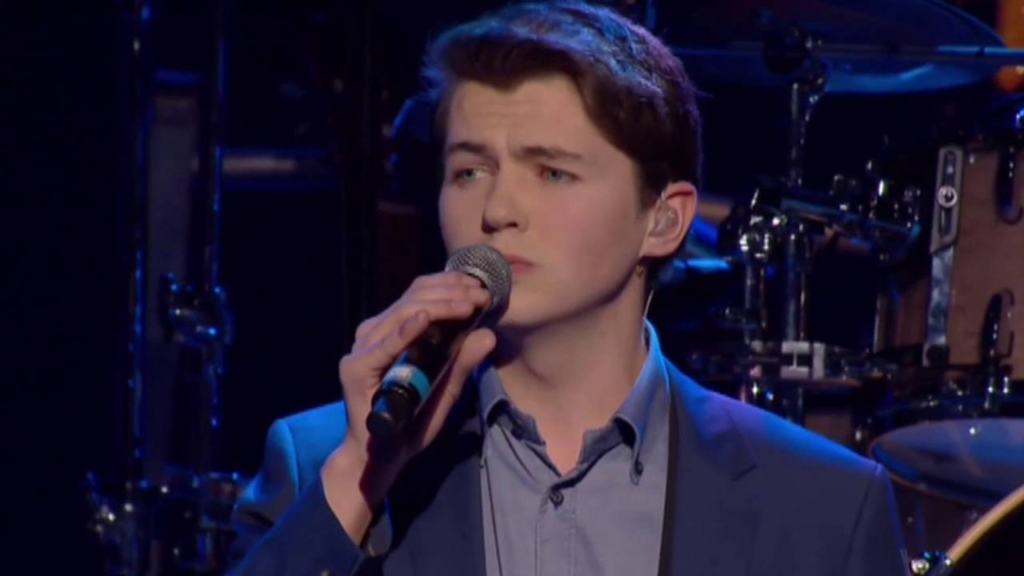
When he reached the final emotional turn of the song, the audience seemed completely surrendered to the moment. The words hanging in the air no longer felt like lyrics alone. They felt like a farewell. A question left unanswered. A reflection of every family that has ever waited for someone who never returned home.
And when the song ended, something remarkable happened.
The audience did not immediately erupt into applause.
For a few seconds, no one seemed willing to interrupt the silence.
That pause may have carried as much emotional weight as the song itself. It was the kind of silence that tells performers they have reached beyond entertainment and touched something personal inside the people listening.
Damian McGinty, alongside Emmet Cahill, Neil Byrne, and Ronan Scolard, had done more than perform a beloved song. Together, they had created a living moment of remembrance inside a concert hall.
When the applause finally arrived, it sounded different from ordinary applause. It was softer at first, almost careful, before gradually filling the room. People were not simply applauding strong vocals or beautiful harmonies. They were responding to the feeling Celtic Thunder had created—a feeling tied to memory, sacrifice, grief, and the strange comfort music can bring when words alone are not enough.
That is why fans continue to talk about Damian McGinty’s performance of “The Green Fields of France.”
Not because it was grand or flashy.
But because it was honest.
Damian McGinty stepped onto the stage, trusted the song, and allowed its story to speak for itself. In doing so, he reminded everyone listening that behind every memorial is a human life, behind every name is a family, and behind every truly unforgettable song is a silence people are reluctant to break too quickly